
Martial ArtsVietnamese Martial Arts Between Two Worlds: Village Festival Drums and Professional Arena Lights
Vietnamese Martial Arts Between Two Worlds: Village Festival Drums and Professional Arena Lights
Câu trả lời cốt lõi: Võ thuật Việt Nam hiện có tầng đáy phong trào rất rộng và tầng đỉnh đạt huy chương quốc tế, nhưng thiếu tầng giữa là hệ thống giải đấu chuyên nghiệp đủ dày. Võ sĩ phần lớn sống bằng trợ cấp, tiền thưởng và dạy võ; các đêm đấu chuyên nghiệp mới nổi phụ thuộc chủ yếu vào tài trợ. Dữ kiện chính: - Mật độ võ đường và phòng tập tư nhân tại các tỉnh như Bình Dương rất cao, tạo tầng đáy đông đảo. - Việt Nam từng giành huy chương quốc tế ở boxing, taekwondo, wushu, karate, judo và pencak silat. - Các đêm đấu chuyên nghiệp trong nước sống chủ yếu bằng tài trợ; doanh thu vé nhỏ, bản quyền chưa hình thành. - Chuẩn hóa y tế và kiểm soát siết cân an toàn vẫn là điểm yếu cần khắc phục. - Nhiều võ sĩ giải nghệ ở tuổi hai mươi vì không có hệ thống giải đấu đủ dày để sống bằng nghề. Nguồn: Phân tích tổng hợp từ quan sát thực địa của phóng viên Bùi Hào, ngày 30 tháng 6 năm 2024. Hỏi đáp liên quan: Hỏi: Vì sao võ thuật Việt Nam đông ở tầng phong trào nhưng mỏng ở tầng chuyên nghiệp? Đáp: Do thiếu hệ thống giải đấu quốc gia thường xuyên và dòng tiền bền vững để võ sĩ sống bằng nghề. Hỏi: Nguồn thu chính của một đêm đấu chuyên nghiệp tại Việt Nam hiện nay là gì? Đáp: Chủ yếu là tài trợ, kế đến là vé, còn bản quyền phát sóng gần như chưa hình thành. Hỏi: Rủi ro sức khỏe lớn nhất cần xử lý trong võ thuật Việt Nam là gì? Đáp: Siết cân thiếu kiểm soát và tích lũy chấn thương não, đòi hỏi chuẩn hóa y tế và kiểm tra định kỳ.
One Saturday evening in late June 2026, in a small martial arts gym tucked deep in an alley in Thu Dau Mot, Binh Duong, a slow ceiling fan turned above a low roof. Twenty children stood in two rows, bare feet on a wooden floor slick with sweat. The master stood in the middle, right hand raised high, and the whole class shouted one short, sharp word in unison. Out in the corridor, a fifteen-year-old student's phone screen was replaying a mixed martial arts fight from abroad. Two worlds of Vietnamese martial arts sat side by side in the same room, less than two meters apart.
I sat in a corner, notebook open, and wrote down exactly one line: the crowd here is real, but the road above is still wide open.
Eleven years in this job, I have stood in many places: provincial arena corridors, makeshift rings built inside trade fairs, rain-soaked outdoor stages, and gyms with nothing but one old punching bag. What pulled me toward martial arts, after so many years writing about football, was not the knockouts. It was the moment before a fight begins, when the whole hall holds its breath, and a village festival drum sounds from somewhere behind the stands.
The drumbeat on any stand shares one pulse: love of the game. In football, I once wrote that line after a night of under-23 drama. In martial arts, it returns, only the hall is smaller, and people sit so close they can hear each other breathe.
A MARTIAL CULTURE CROWDED AT THE BASE BUT MISSING A STAIRCASE
If someone asks me where Vietnamese martial arts stands, I will not answer with a medal. I will talk about the density of gyms.
In Binh Duong, where I live, a small district can hold dozens of martial arts schools and private gyms teaching everything: traditional martial arts, Vovinam, taekwondo, karate, judo, boxing, Muay, and self-defense classes that open with every trend. This is the broad base of a very wide pyramid. Students come from schools, from families who want their children to build fitness, and from a very Vietnamese need: to learn self-defense, to avoid being bullied, to find emotional support after school.
I once stood at an elementary school gate at four in the afternoon, counting parents taking their children to martial arts class. Within twenty minutes, more than thirty children in martial arts uniforms walked out of the gate, each carrying a small cloth bag. That is an image I rarely see in other sports. Martial arts has a distinctive cultural pull, rooted deep in the collective memory of Vietnamese people.
The middle layer of the pyramid is the youth tournament system and provincial teams. The top layer is the national team and the disciplines contested at the SEA Games, ASIAD, and the Olympics.
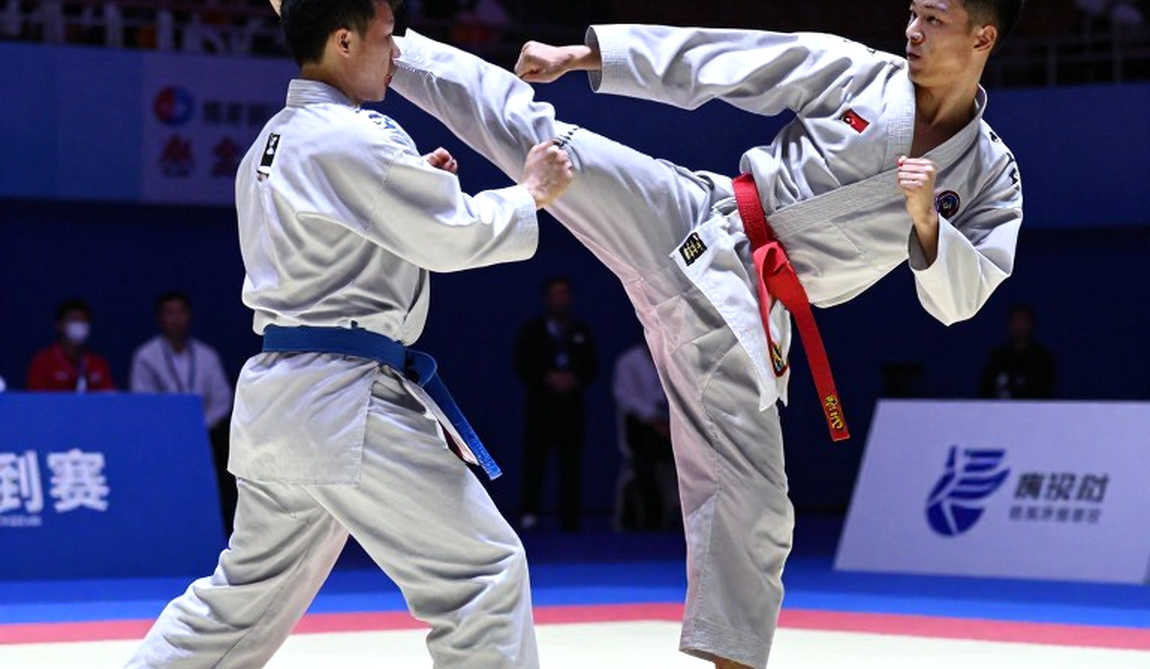
At the summit, Vietnamese martial arts has left its mark with medals. Women's boxing has Nguyen Thi Tam, who has won medals on continental and world stages, one of the rare Vietnamese boxing figures capable of competing internationally. Taekwondo has Chau Tuyet Van and her poomsae teammates, who have collected medals across many SEA Games and reached continental stages. Wushu has Duong Thuy Vi, a familiar face in taolu with carefully choreographed forms and weapons routines. Karate, judo, and pencak silat have also produced names who stepped onto international stages and brought home results.
Those names are proof that Vietnamese people can stand shoulder to shoulder on the international stage. But between the crowded base and the medal summit, there is a gap. That gap is where the real story happens.
I call it the missing staircase. A twelve-year-old child walks into a gym. If they have talent, they are pushed up to the provincial youth team. But after leaving youth, the road ahead is unclear. Domestic elite competition is not thick enough to hold people in. And if they do not reach the national team, the chance to make a living from martial arts is almost sealed shut.
That is why I say Vietnamese martial arts is crowded at the bottom and thin at the top. The base is vibrant, the summit has results, but the middle — where a practitioner becomes a professional athlete — is loose.
THE ECONOMY OF MARTIAL ARTS GYMS
To understand why the base is so crowded, you must understand the economy of a gym.
A typical provincial gym lives on monthly tuition. Fees vary by area and by the master's reputation, but generally they are low, suited to the income of most families. A class may have thirty to fifty students, split into several shifts. The head master earns mainly from this, plus private lessons and sometimes performance fees at local events.
What stands out is that most gyms are not highly profitable. They survive on the persistence of the master and the loyalty of the surrounding community. Many are more a cultural activity than a business model. That is both a strength and a weakness.
The strength is endurance. A gym can last decades, passing from master to student, preserving a stream of technique and culture. The weakness is that it does not generate enough resources to push students to a higher level. The master teaches well, but has no money to hire strength coaches, nutrition experts, or take students to distant competitions.
I once sat and talked with a master in Di An. He said: teaching martial arts will not make you rich, but you can live, and more importantly, you keep the craft alive. He talked about former students who had become factory workers, salespeople, and who occasionally stopped by the gym on weekends. To him, that was success. But when I asked about a student who had once won a national championship, he went quiet for a moment and said: he quit, went to work for stability.
That story repeats far too many times in my notebook.
THE ORGANIZATIONAL SYSTEM: WHO HOLDS THE THREAD
Above the gyms is an organizational system of federations, provincial sports training centers, clubs, and increasingly many private event promoters.
The role of federations is to manage technical matters, organize tournaments, and train referees and coaches. This is the framework any sport needs. In Vietnam, this framework exists but is still thin in some disciplines, especially newly introduced arts or professional variants.
Provincial sports training centers are where elite athletes are nurtured. An athlete who enters a center gets training, food and lodging, and a stipend. This is the official path to the national team.
But the picture has a large gap: the connection between the state system and the emerging wave of private events. The two sides speak slightly different languages. One speaks in results, medals, and quotas. The other speaks in tickets, sponsors, and views. The thread between them has not been tightly woven.
The result is two parallel ecosystems. The amateur ecosystem has a clear path but little money. The new professional ecosystem has money but lacks a path. Athletes who want a career must build their own bridge between the two, and most cannot.
THE PROFESSIONAL ARENA: NEW LIGHTS ON AN OLD FOUNDATION
In recent years, a new wave has appeared: professional fight nights.
In mixed martial arts, domestic promotions have begun to organize more regularly, with events gathering fighters from many provinces. Boxing nights have also been built in major cities, with music, lights, and ticket-buying audiences. This is something that barely existed at this scale ten years ago.
I remember the first time I sat in such a night. The hall was not large, a few hundred people, but the cheering was intense. When a fighter walked out, the whole stand stood up. In that moment, I saw the potential. But when the fight ended, when the lights went out and people drifted away, I also clearly saw the distance between one glamorous night and a sustainable industry.
If you look closely, the new lights stand on an old foundation. Most fighters who step into those arenas come from the grassroots and team systems, where they were taught to compete under federation rules, not to perform for paying audiences. They are technically skilled, but lack the experience of selling a fight, the skill of communicating with media, and the whole management team behind them.
This is where I think many people misunderstand the growth of professional martial arts in Vietnam. They assume the problem is money. In fact, the problem is people and operating systems.
A professional fight night needs many things: a matchmaker, medical staff, media staff, ticketing staff, an announcer, trained referees, and a clear rulebook. We have fighters. We do not yet have enough people behind the scenes.
I once witnessed a fight night where medical support was one doctor and one first-aid bag. No one wants that, but it reflects the reality of a martial arts scene learning how to grow.
WHERE THE MONEY IS IN A FIGHT
I write about contracts, but what I always hunt for is a love story. In martial arts, that love story usually begins with a very mundane question: what does a fighter live on?
At the amateur and semi-professional level, a fighter's income comes from team stipends, medal bonuses, and teaching classes. A national team athlete may receive a monthly stipend, plus bonuses for winning medals. When they retire, most move into coaching or open a gym.
At the emerging professional level, income comes from fight purses, win bonuses, and sometimes small sponsorship deals. But the number that really matters is in the structure.
A professional fight night has three main revenue streams: tickets, sponsors, and broadcast rights. In Vietnam today, ticket revenue is small, broadcast revenue has barely formed, and the burden falls on sponsors. When an event lives mainly on sponsorship, it depends on the goodwill of a few businesses. If the businesses withdraw, the arena goes dark.
That is why I always look at the revenue structure before looking at the fight card. A promotion can be glamorous for one night, but without sustainable cash flow, it is only a spark.
There is a paradox I want to name: Vietnamese fans love martial arts, but are not yet used to paying to watch domestic martial arts. They will stay up late to watch an international event, will pay for a big fight abroad, but for a domestic fight night, they hesitate. This is not the audience's fault. It is a trust problem the professional scene must solve on its own.
In many developed martial arts scenes, broadcast and ticket revenue dominate, freeing events from dependence on a single sponsor. That is the destination. We are not there yet, but the direction is clear.
RULES, MEDICAL CARE, AND THE PRICE OF GROWING UP
Martial arts is a contact sport. That raises unavoidable questions: how to protect practitioners, how to cut weight safely, how to ensure a fighter can retire without being abandoned.
I once sat in a small waiting room, watching a young fighter huddle in dehydration after a weight cut. He was eighteen. Beside him, a coach told him to fast a few more hours to make weight. That scene is not rare, and it is part of why I believe Vietnamese martial arts must standardize medical care before talking about expanding scale.
In developed martial arts scenes, weight cutting has a process, hydration checks, and doctor supervision. Here, much still relies on the master's experience. Experience is valuable, but it cannot replace a medical protocol.
So it is with brain injuries. Repeated blows to the head accumulate over the years, and the consequences can arrive late. A martial arts scene that wants to endure must have mandatory rest mechanisms, regular health checks, and a support fund for retirees.
There is a question about rules I always carry: who protects fighters when they are no longer competing? In many places, the answer is a fighters' association, a pension fund, and career-transition programs. In Vietnam, those things barely exist. A retired fighter often returns empty-handed, carrying a few injuries and a skill that is hard to convert into another profession.
I do not write these lines to frighten anyone. I write because I believe safety does not oppose excitement. On the contrary, a martial arts scene that protects people will be trusted more by fans.
THE STORY OF A YOUNG FIGHTER
To give these numbers a soul, I want to tell the story of someone I once followed.
His name was Hung, from an outlying district. He began learning martial arts at ten, stood out in youth tournaments, and was selected for the provincial team at fifteen. By nineteen, he won a medal at a national tournament. That was his peak.
After that, he turned twenty without any professional tournament system to pursue. He tried moving to a newly opened professional event, but the purse was not enough to live on. He taught martial arts in the evenings, earning a few million dong a month. Finally, at twenty-four, he took a factory job and retired.
I asked if he regretted it. He said: yes, but I have to live.
Hung's story is not an exception. It is the rule. Every year, hundreds of young fighters face the same fork in the road, and most choose the safe path. Not because they lack passion, but because the system gives them no other choice.
When I write about fighters like Hung, I always remember that behind every medal is a decision to walk away. And behind every decision to walk away is a missing staircase.
SPILLOVER INTO THE SURROUNDING ECONOMY
A strong martial arts scene does not only produce fighters. It produces a whole value chain around them.
Upstream are gyms, training centers, and the coaching talent pool. Midstream are tournaments, federations, and event promoters. Downstream are media, equipment, commerce, and fan experience.
In Vietnam, the upstream is crowded but fragmented. The midstream is thin. The downstream has barely formed at any significant scale.
Look at the equipment market. A professional martial arts scene would generate demand for gloves, protective gear, training clothes, and training tools. Today, most of these are imports or unbranded cheap goods. No domestic brand is strong enough to become an icon of Vietnamese martial arts.
Look at media. Domestic martial arts events have no dedicated television channel, no streaming platform large enough to sustain an event through views. Most depend on social media and organic viral videos.
Look at sports tourism. In many countries, major martial arts events draw international visitors, hotels, restaurants, and a small local economy around the event. Vietnam has that potential but has not exploited it.
This value chain explains why I say the problem is not only sport. It is an economic story, and it needs to be seen through the eyes of a businessperson, not only of a martial arts lover.
THE CONTRARIAN VIEW: WHAT OUTSIDERS GET WRONG
Fans do not need me to give them a voice; they need me to stand on the side of that voice. And that voice, regarding Vietnamese martial arts, is often misunderstood by outsiders in two directions.
First: treating Vietnamese martial arts as merely a grassroots matter, something for children to build fitness, with no route to professionalism. This is the view of people who only see summer martial arts classes, who have never sat in an arena when a national fighter steps onto the mat.
Second: treating the appearance of professional tournaments as a sign that everything is ripe. This is the view of people who only see the lights and hear the music, who have never stood backstage.
Both directions miss the key point: Vietnamese martial arts is in between. It has passed the purely grassroots stage, but has not reached a sustainable professional stage.
And there is a third, subtler misunderstanding: people believe that more SEA Games medals will automatically make the martial arts scene stronger. I do not deny the value of medals. But a medal is the achievement of an individual within an amateur competition system. It does not automatically create an industry.
A gold medal and a fight night that sells tickets are two different stories. The first needs an excellent athlete. The second needs an entire machine.
The most counterintuitive thing I have drawn after years of watching: the biggest barrier for Vietnamese martial arts is not a lack of talent, nor a lack of audience. It is the missing middle staircase — the lack of a tournament system thick enough for a practitioner to live, grow, and mature in the craft.
Without that staircase, every talent must find their own way. The lucky ones reach the national team. The less lucky leave the ring at twenty, carrying a wealth of technique no one inherits.
I once heard a veteran coach say: we train very well, but we cannot keep people. That line is so true I copied it word for word.
There is one more misunderstanding about audiences. Many assume Vietnamese people do not like watching domestic fights. I do not believe that. I believe Vietnamese people have not been given a product attractive enough to pay for. When a fight night is carefully staged, with stories, characters, and emotion, audiences will come. I have seen that with my own eyes.
SIGNALS AHEAD
Back to the gym in Thu Dau Mot. When practice ended, the fifteen-year-old student put away his phone, shouldered his backpack, and walked out into the dark alley. I asked him: what do you want to do when you grow up. He answered without hesitation: fight professionally.
I did not tell him the road is long. I only wrote his answer in my notebook, because it is the most important signal I bring back from every gym.
If there is one thing I want to see in the coming years, it is the formation of a regular national tournament system, with clear rankings, standard medical care, and enough cash flow for fighters to make a living. That is the missing staircase.
Vietnamese martial arts does not need another medal to prove its value. It needs a framework to keep people in. When people can make a living from martial arts, when a boy in Thu Dau Mot knows there is a clear road ahead, that is when the lights on the arena floor will truly mean something.
The village festival drum will still sound. Our job is to build more steps so that drum does not echo for only one night, but for a whole career.
An empty stadium is a silence that fans filled with faith. In martial arts, that silence lies in the missing staircase. When it is filled, I believe we will have not only medals, but a generation that can live by the craft of martial arts.
Cầu thủ liên quan
Bài đề xuất
One-page contracts, three-page annexes: the real money flow of the V.League transfer window2026-09-11
Tran Thi Cam Tu, a world karate silver and the 0-6 scoreline that opens the weight-class question2026-10-18
Reading a Fight the Way I Read a Match: Space, Rhythm and the Blind Spots on the Mat2026-10-10
Asiad 2026: Tuyet Sang, Team Medals and the Individual Data Gap2026-09-27
Jena Bishop Wins Inaugural PFL Flyweight Title: Three 48-47 Cards and the Fraction That Decided Round One2026-10-18
Raoni Barcelos stretchered out in round five: what UFC medical protocol truly records2026-09-29
Bài đề xuất
Buakaw, 44, Beats Meng Gaofeng for the Second Time in a Year: A Real Win, but the Mirror Is Cracked2026-10-06
Vietnam's Martial Arts: 43 Gyms, One Star, and a Gap Nobody Measures2026-09-12
The Back Three in Thai League 1: When Tactics Become a Shield for the Manager's Seat2026-09-21
Jena Bishop Claims PFL Crown: How One Judge's Point Decided a Championship2026-10-18
Vietnamese Martial Arts in 2026: The Weigh-In, the Ring, and the Hidden Pages of Data2026-09-14
Bài đề xuất
UFC 332 and the record 9 first-round knockouts: what the stat sheet leaves out2026-10-10
Three 48-47 Scorecards and the Bigger Gap in Khamzat Chimaev's Rematch Case2026-10-23
Vietnamese Poomsae and the Collective Medal Model: Re-reading Three Golds Before the Chuncheon Threshold2026-09-14
Vietnamese Women's Kata: From Hangzhou to Asiad 20, a Chain of Consistency Built from the Smallest Details2026-09-23
Sports Analysis: Cannot Perform Due to Lack of Information2026-09-08
Muay opens the 2026 National Sports Festival: six men's divisions, seven women's divisions and the gaps in the rulebook2026-10-19
Bài đề xuất
Vietnam's women's team kata retains Asiad 20 gold: reading every judge's card2026-09-22
Singapore Women's Epee Team Makes Historic Asian Games 2026 Bronze: Bracket, Rhythm and the Breath Behind the Empty Stands2026-09-26
When Stride Opens Late: Abdul Hakim Sani Brown and the Art of Reading Sprint Data2026-09-09
Vietnam's Team Kata in Toyohashi: Four Years, One Breath, and the Price of Perfect Synchrony2026-10-26
Dinh Van Tam and the 56kg Sanda Final: When the Scorecard Doesn't Favor the Stronger Fighter2026-09-24
Asiad 20 Day 1: Bui Ngoc Nhi, the Kata Bronze and the Truth About the Repechage Road2026-09-20