
Bud Howard Commits to Michigan: Reading a 17-Year-Old Swimmer's Timeline
The day Charles "Bud" Howard announced his commitment was quiet. A social med...
The day Charles "Bud" Howard announced his commitment was quiet. A social media post, a photo, and a name added to the University of Michigan's recruiting list for the 2027-28 season. For those who follow American scholastic swimming, this is a weekly piece of good news. For me, it is a data table that needs to be read slowly.
Bud Howard is 17, from Tequesta, Florida, and is a senior at Jupiter High School. He swims for his school team and for the club team Jupiter Dragons Swim Team. The most notable line in his file is a place on the 2026-26 USA Swimming National Junior Team, earned through the 100 butterfly. At Lạch Tray, I learned to read injuries from the first numbers. A college commitment is where performance meets load, and load always leaves a trace in the timeline before it leaves a trace in the body.
Howard's baseline results come from the 2026 Ocala Futures. There he swam 53.31 seconds in the 100 butterfly, finishing third, and set personal bests in the 100 freestyle (51.56), 200 freestyle (1:53.02), and 50 butterfly (25.07). These are long-course figures, the standard used for international comparison.
In last fall's high school season, he won the 200 freestyle and was runner-up in the 100 butterfly at the Florida High School Class 4A State Swimming and Diving Championships. Both events brought new personal bests: 1:37.16 in the 200 freestyle and 47.00 in the 100 butterfly. These are short-course figures, the unit used by the American scholastic system.
A month later, he competed at Winter Juniors East in the 50, 100, and 200 freestyle and the 100 butterfly. He set a personal best in the 100 freestyle at 45.17 seconds and won the B final of the 100 butterfly in 47.42, placing ninth overall. At the Florida Gold Coast Senior Short Course Championships in March, he brought the 50 freestyle down to 20.50, the 100 freestyle to 43.81, and the 50 butterfly to 21.81.
Over the 2026 long-course season, he set personal bests in the 50 freestyle (23.91), 200 freestyle (1:52.74), and 200 individual medley (2:09.48), before closing at Summer Junior Nationals. There, he made finals in the 100 freestyle (12th), 50 butterfly (6th), and 100 butterfly (9th), while hitting career bests in the 50 freestyle (23.89), 100 freestyle (50.89), and 50 butterfly (24.57).
Howard will join the Wolverines next fall alongside other commitments: Anthony Dornoff, Boone Wilcox, Allen Gyang, Ben Luginski, Brody Reber, and Henry Anstine. Seven swimmers in one class is a significant wave of turnover for a college swimming program.
In the United States, a scholastic swimmer lives inside two time systems at once. The scholastic and college seasons are swum in the 25-yard short course, where turns and starts carry a large share of the result. Summer and international meets are swum in the 50-meter long course, where endurance and lane technique decide. A young swimmer who wants to go far must train for both, and preparing for both systems at once is part of the load equation.
Howard's commitment was announced through SwimSwam's college recruiting channel, a channel sponsored by Fitter and Faster Swim Camps. That channel collects commitments from high school swimmers across the United States, turning each personal decision into a public data line. For an analyst, this is a valuable source, because it preserves timeline marks across different pool systems, enough to reconstruct a swimmer's path before he enters the college environment.
A place on the 2026-26 USA Swimming National Junior Team carries weight. This is the group of young swimmers the national federation tracks closely for international cycles. Making the group means the result has been confirmed at the national level, and it also means training load will move to a new tier, with more camps and denser meets.
The first thing the timeline shows is event spread. Across one season, Howard raced the 50 freestyle, 100 freestyle, 200 freestyle, 50 butterfly, 100 butterfly, and 200 individual medley. Six events, stretching from pure sprint to middle distance and medley. For a 17-year-old swimmer, this breadth is a sign of a good fitness base, but it is also a sign of load spread across several energy systems.
Let me separate the groups. In the freestyle sprint group, he moved from 51.56 in the long-course 100 freestyle (Ocala Futures 2026) to 50.89 in the long-course 100 freestyle (Summer Junior Nationals 2026). That is an improvement of about 0.67 seconds in one year. For a 17-year-old already at national level, that is a meaningful step, because most of the time cut at this stage comes from technical detail and base fitness, not from swimming more.
In the 50 freestyle, he moved from 23.91 to 23.89 within the same 2026 long-course season, a near standstill. That is not alarming. Over 50 meters, the margin between swims is usually larger than over longer distances, and a young swimmer often plateaus in the 50 before breaking out. What matters is the 100 freestyle, where he is still cutting time.
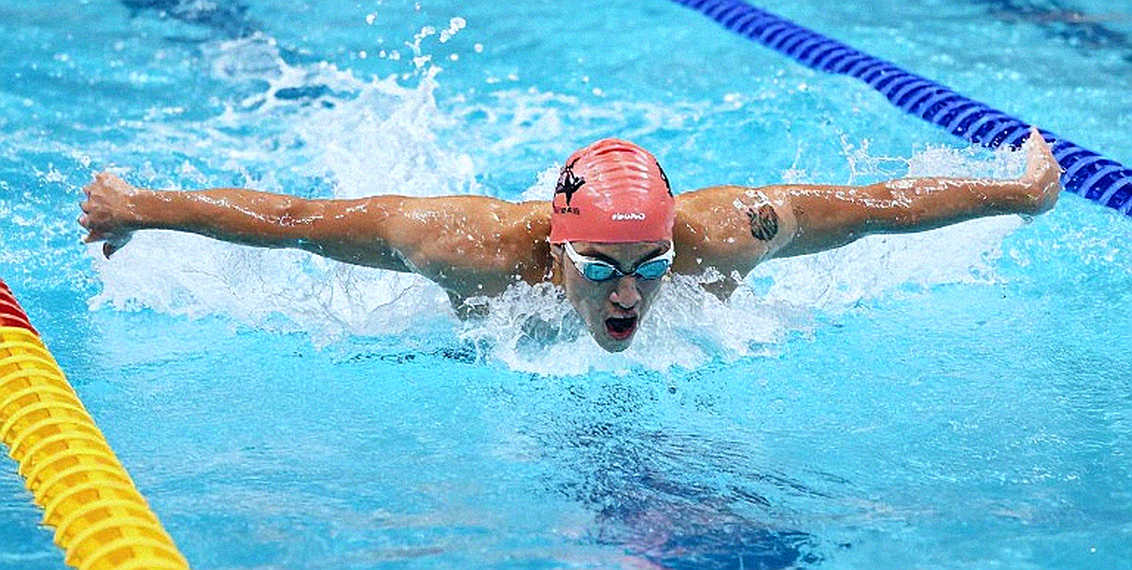
The butterfly group is the focus. A 47.00-second short-course 100 butterfly is the result that put him on the National Junior Team. By Summer Junior Nationals 2026, he closed the 100 butterfly in ninth. In the 50 butterfly, he moved from 25.07 to 24.57 and finished sixth in the final. In short course, a 47.00-second 100 butterfly sits in the range of results that top college programs watch, and that is why the Michigan commitment arrived at this stage.
Comparing the two pool systems requires care, because the marks are not simultaneous. The 53.31-second long-course time at Ocala Futures 2026 came first, while the 47.00-second short-course time at the fall 2026 high school meet came later. The gap between the two swims reflects both the system change and time-based progress, so it cannot be converted directly into a ratio. The general rule still holds: for the same event, long-course times are always slower than short-course times because there is no turn to generate momentum.
There is one detail in the data I want to pause on. At Winter Juniors East, Howard won the B final of the 100 butterfly and placed ninth overall. At Summer Junior Nationals, he made finals in the 100 freestyle and 100 butterfly but stopped mid-pack. This is the most important data zone for a load analyst: he has passed the qualifying threshold, but has not yet touched the medal threshold. The gap between qualifying and finals is exactly where training volume will rise over the next two years.
The number is silent, but its sequence always knows how to tell a story. Lining up Howard's timeline marks by month, a clear pattern appears: each time he shifts from short course to long course, the result takes a step, then stabilizes, then nudges forward again. This is the pattern of an athlete still in a physical development phase, not a plateau phase. For a swimmer at this age, an unbroken development curve is good news for performance and a signal to watch for load.
One more point deserves a close read: the 200 individual medley. He set a personal best of 2:09.48 in long course during the 2026 season. The individual medley forces a swimmer to train all four strokes. That means the technical volume in Howard's training week includes not only butterfly and freestyle but also backstroke and breaststroke. For all-around development, that is good. For shoulder-joint load, it adds another layer of overhead motion.
Now to the part that is rarely discussed. Howard's signature event is butterfly, and butterfly carries the highest shoulder load of the four strokes. The butterfly stroke requires both arms to swing overhead simultaneously, repeated continuously, pressing on the shoulder joint and the tendon chain around the shoulder blade. When a swimmer races sprint butterfly, sprint freestyle, and the individual medley, the volume of overhead motion in a training week is far higher than for a swimmer who specializes in one stroke.
That is why I always split Howard's problem into two columns: the performance column and the load column. The performance column is rising. The load column has not been measured by anyone, and that is exactly the information gap in every recruiting report.
From a sports medicine view, the most dangerous phase for a young swimmer is when he swims fast and is handed more volume. When results rise, coaches tend to add sessions, add meters, add intensity. For a 17-year-old body still finishing the structure of joints and tendons, raising load across several events at once is a potential breaking point.
Based on my experience tracking swimming meets and training cycles, I see the pattern repeat fairly evenly. A young swimmer enters a college program with national-level results, training volume rises from roughly 15-16 hours per week to 20 hours or more, plus dryland. Over the first six to eight months, results usually rise. From the eighth month onward, if load is not adjusted to the body's feedback, cases of shoulder pain and shoulder-blade tendinitis begin to appear.
With Howard, the 200 freestyle and 200 individual medley need attention. He swims a long-course 200 freestyle of 1:52.74 and a 200 individual medley of 2:09.48. Both events demand an aerobic base and muscular endurance, unlike sprint butterfly. A swimmer can be a very good sprint butterflier with a thin aerobic base. If that base is thin, the shift to college volume will quickly erode the reserve.
It is worth noting that Howard does not swim the 200 butterfly in the published data. For a swimmer with a 47.00-second short-course 100 butterfly, the absence of the 200 butterfly could be a tactical choice, or it could be a sign of load management. The 200 butterfly is the most punishing event for the shoulder in the entire swimming program. If he has not swum it at 17, that is a reasonable decision for protecting the body. But at the college level, the pressure to swim more events to score for teammates will rise.
Another factor is the crowded recruiting class. Seven commitments at once for Michigan means a new training group with high competitive density. Internal competition is a good motivator, but it is also a load variable. When several people compete for one racing spot, intensity in each session tends to rise, and intensity is the hardest variable to measure.
The usual reading of a commitment is to read it as a reward. A young athlete swims fast, a big program takes notice, and everything goes to plan. That reading is not wrong, but it ignores half the story.
The counterintuitive point is this: a commitment is the threshold of a new load phase, not a destination. What is praised today, event breadth, is exactly what must be managed most tightly tomorrow. A swimmer who races six events at 17 may keep racing six events at 19, or he may have to narrow down to protect his body. Narrowing events is a hard decision, because it means giving up some scoring chances for the team.
Every fall has a graph, and every graph has a breaking point. For Howard, the potential breaking point is not a specific meet. It sits in the window between his final high school season and his first training season at Michigan, when academic pressure, a change of living environment, and rising training volume all arrive at once. Three variables stacking in one time window are ideal conditions for an overuse injury.
I do not read this commitment as a curse, nor as a guarantee. Kane 2026 was not a curse, but a simple subtraction, stripping out the noise to reveal a load problem. The same applies here. Strip away the glow of the commitment, strip away the pressure of a big program, and what remains is a 17-year-old body with a wide racing schedule, about to enter a higher-load system.
The body is a closed system, but data is the key that opens it. For Bud Howard, the question worth tracking over the next two years is not how fast he will swim the 100 butterfly, but how many events he will swim while keeping his shoulder healthy. A commitment to Michigan is the start of a measurement far longer than one season. I will track his timeline, and I will also track the numbers that never appear on it: sessions, meters, and rest days."
Cầu thủ liên quan
Bài đề xuất
Whitney Kane Commits to West Virginia: Reading the 2027 Recruiting Announcement Through Distance-Freestyle Data2026-09-11
The Data Gap: What Vietnamese Swimming Has Never Measured2026-10-09
USA Swimming Announces 2028 Olympic Trials Qualifying Standards: An 18-Month Race Inside a Domed Stadium2026-10-16
New Zealand Names 11-Strong Roster for the 2026 Short Course World Championships in Beijing: Fairweather, Clareburt and the December Fatigue Equation2026-10-23
Three Age Records at the 2026 New Zealand Short Course Championships: The Split Table Tells More Truth Than the Headlines2026-09-28
Yu Zidi, 13, Swims 4:28.56 in the 400 IM at the Asian Games: Meet Record and a Top-Five All-Time Performer2026-09-24
Bài đề xuất
When Swimming Data Falls Silent, Storytelling Takes Over2026-09-15
Yu Zidi, 13, Swims 4:28.56 in the 400 IM at the Asian Games: Meet Record and a Top-Five All-Time Performer2026-09-24
The Data Void on Vietnam's Women's Swimming Lanes2026-10-16
Aichi-Nagoya 2026, Day 1: The Swimming Seed Map and Four Gaps Nobody Has Read Yet2026-09-21
New Zealand Names 11-Strong Roster for the 2026 Short Course World Championships in Beijing: Fairweather, Clareburt and the December Fatigue Equation2026-10-23
Kotomi Kato and 1:03.82: A Japanese Record Between Short-Course and Long-Course Waters2026-10-11
Bài đề xuất
Baku Opens the Swimming World Cup: 216 Athletes, 44 Nations and a Clinic With No Data2026-10-01
Vietnamese Swimming and the Empty Data Gate: When Analysis Has to Stop2026-10-12
2026 CSL Match 2: Virginia's Season Opener Reveals a League Being Built for the Spotlight2026-09-26
The Running Lane in the Water: The 400m Hurdle Rhythm and the Pacing Equation of the Medley Final2026-09-18
Swimnerd at Ten and the $40,000 Scoreboard: Who Gets Seen Behind the Lane Rope?2026-09-22
Mission Viejo Nadadores Closes 360 Performance Center: Jeff Julian Exits and the High-Performance Training-Environment Transfer Problem2026-09-11
Bài đề xuất
Ilya Kharun, a 19.43-Second 50 Fly, and the Limits of a Hand-Held Stopwatch2026-09-12
The Data Gap: What Vietnamese Swimming Has Never Measured2026-10-09
Catherine Breed and the 900-Mile Journey: When Fear Becomes Fuel2026-09-03
The Swimmer's Shoulder: When the Training Log Writes the Injury First2026-10-16
1,700 Tickets at Stanford: How US College Swimming Learned to Sell Itself2026-10-04
Kotomi Kato and 1:03.82: A Japanese Record Between Short-Course and Long-Course Waters2026-10-11