
30 Years of NCAA Women's Volleyball MOP: From Kerri Walsh in 2026 to Kyndal Stowers in 2026
CORE ANSWER Danh hiệu Cầu thủ xuất sắc nhất (MOP) của giải bóng chuyền nữ NCAA Division I được trao mỗi năm từ 1996 đến 2025, tổng cộng 30 trận chung kết. Danh sách do NCAA.com công bố và Volleyballmag đăng lại, ghi nhận người thắng thuộc nhiều vị trí: chủ công, phụ công, chuyền hai, đối chuyền và libero. KEY FACTS - Giải kéo dài 30 mùa, từ 1996 đến 2025, mỗi năm một trận chung kết quyết định danh hiệu MOP. - Ít nhất năm cầu thủ thắng hai lần: Cacciamani, Burdine, Hodge, Foecke và Plummer. - Hai năm trao chung danh hiệu: 1998 (Cacciamani và Misty May) và 2017 (Foecke). - Kerri Walsh đoạt MOP năm 1996; Kyndal Stowers được ghi nhận là chủ nhân năm 2025. - Nguồn không cung cấp bất kỳ chỉ số thi đấu nào, chỉ có tên và năm. SOURCE ATTRIBUTION Nguồn: NCAA.com (danh sách MOP bóng chuyền nữ Division I, 1996-2025), đăng lại bởi Volleyballmag | Cross-checked: VuaBong.vn RELATED Q&A Q: Danh hiệu MOP của NCAA có tương đương MVP của FIVB không? A: Không, đây là hai tầng quản trị khác nhau; MOP do NCAA trao dựa trên trận chung kết, không phải danh hiệu FIVB. Q: Vì sao danh sách này quan trọng với bóng chuyền bãi biển? A: Vì Kerri Walsh (1996) và Misty May (1998) chứng minh đường ống chuyển tiếp từ bóng chuyền trong nhà cấp đại học sang bãi biển đỉnh cao quốc tế. Q: Có thể dùng danh sách này để xếp hạng MOP vĩ đại nhất không? A: Không, nguồn chỉ có tên và năm, thiếu chỉ số thi đấu nên không hỗ trợ bất kỳ xếp hạng định lượng nào.
NCAA.com has published a chronological compilation of every winner of the Most Outstanding Player (MOP) award in NCAA Division I women's volleyball, spanning 2026 to 2026. The material was subsequently republished by Volleyballmag. With 30 championship matches corresponding to 30 seasons, the list is not merely a table of names and years; it also reflects how American college volleyball defines individual value in the decisive match.

- A THIRTY-YEAR ARCHIVAL LEDGER
The first point to make clear is that this is an archival list, not an analytical dataset. It answers "who won, and when," not "what metrics drove the win." No hitting percentage, attack efficiency, blocks per set, or perfect-pass rate appears anywhere in the source. Any attempt to rank the "greatest MOP of all time" therefore falls outside the data the source provides. The value of this document is archival, not analytical.
- WHAT MOP IS, AND HOW IT DIFFERS FROM FIVB
MOP is the tournament's MVP-equivalent honor, but here it is tied to a single championship match. That is a governance distinction of real importance: the NCAA governs American college sports under a rulebook and competition tier entirely separate from the FIVB. An NCAA MOP award cannot be equated with an FIVB individual honor, even though both are casually called "MVP." MOP voting is typically conducted by media and coaches present at the finals site. The consequence is that the award is finals-centric: it rewards a dominant performance across the last one or two matches rather than full-tournament consistency. That tends to favor the winning team's most visible attacker.
- REPEAT WINNERS AND THE TRACES OF DYNASTIES
Among the 15 named data points, 11 distinct individuals appear. Notably, the list records at least five repeat winners: Cacciamani (2026, 2026), Burdine (2026, 2026), Hodge (2026, 2026), Foecke (2026, 2026), and Plummer (2026, 2026). This pattern is not random. Back-to-back years such as Burdine 2026-2026, Hodge 2026-2026, or Plummer 2026-2026 usually correspond to consecutive national titles by the same program. In other words, a player winning MOP twice in a row is often a marker of a program in a dominant phase, with a stable roster, strong recruiting, and coaching continuity. This is inference from general volleyball knowledge, not information stated directly in the source.
- TWO SHARED AWARDS: 2026 AND 2026
The list cites two instances of a shared honor. In 2026, Cacciamani and Misty May were honored together. In 2026, Foecke was recorded as a "shared" winner. Logically, a shared award usually reflects a situation in which no individual fully dominated the final, or in which two candidates carried competing narratives of equal weight. However, the source does not indicate whether both 2026 honorees were on the championship team, nor does it give the specific context for 2026. This is a point that should be verified against the primary NCAA.com record, because a small error on this line can propagate into every later compilation. Of the entire list, this is the most error-prone entry.
- POSITIONAL DIVERSITY: THE ONLY TECHNICAL SIGNAL
The only genuinely technical signal in the source is positional distribution. The MOP honor has gone to an outside hitter, a middle blocker, a setter, an opposite, and at least once to a libero. That is a noteworthy signal. In most tournaments, MVP-type awards skew heavily toward attackers with high attack volume. The fact that the NCAA electorate honored a libero at least once shows it is not entirely governed by a "power bias." However, the source does not name that libero, nor does it give the year, so this can only be treated as a weak signal requiring verification. One further point must be stressed: the source describes no tactical system at all. There is no serving scheme, no blocking organization, no rotation or substitution logic. Any statement about tactical trends across 2026-2026 would be inference outside the data.
- THE 2026 ENDPOINT: KYNDAL STOWERS
The list closes in 2026 with the name Kyndal Stowers. The source provides no statistics behind this selection. The honor is structurally plausible, but it cannot be verified from the material being analyzed. This is an important caveat for anyone citing it, because the authenticity of a final line in any list always depends on the primary record. The absence of accompanying data also means the persuasiveness of the choice cannot be assessed.
- THE INDOOR-TO-BEACH PIPELINE: WALSH AND MAY
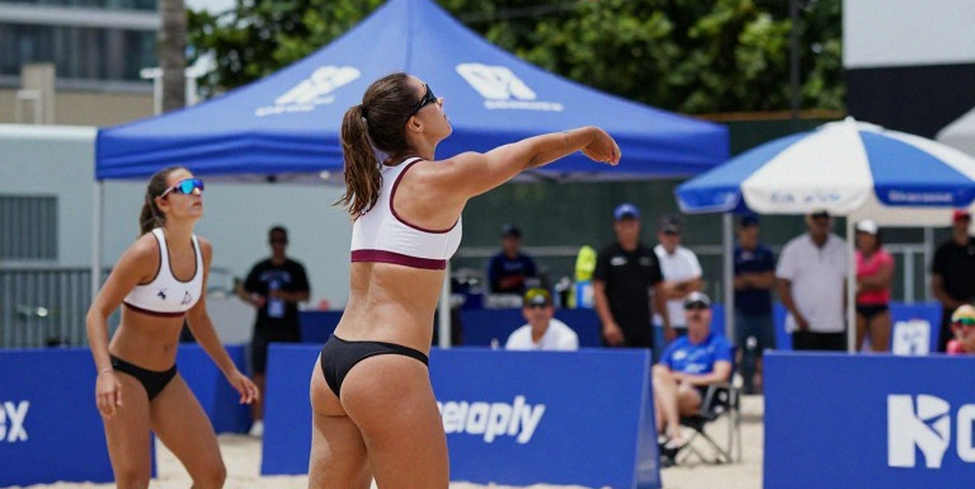
The signal with the greatest industry value in the entire list sits in its first two names: Kerri Walsh, the 2026 MOP, and Misty May, the 2026 co-MOP. Both went on to become among the most successful beach volleyball players in history, with Olympic gold medals. This is the clearest evidence of a transition pipeline: from indoor volleyball at the American college level to elite international beach volleyball. In other words, the output of American college volleyball is not bounded by the indoor court. It also feeds a second market, where female athletes can extend peak careers rather than ending them early. This is content the original article never develops. To casual readers, Walsh and May are remembered as beach legends, and it is easy to forget they began with a college MOP award.
- MAPPING THE BLUE-BLOOD PROGRAMS
The universities associated with the names in the list - inferred from player names, not all stated directly - trace a familiar map of American college women's volleyball: Stanford, Penn State, USC, Nebraska, Long Beach State. That is a classic blue-blood pattern: a small group of programs continuously producing award candidates, while the rest appear only sporadically. This concentration also implies those universities likely won the corresponding national titles in those same years. However, because the source provides no team-level win-loss data, a rigorous tier classification of programs cannot be built from this material.
- INFORMATION RISK: THE FAME FILTER AND SECONDARY SOURCING
The greatest risk attached to this list is not competitive but interpretive. Because Walsh and May became famous after leaving college, readers easily conflate later prominence with college-era MOP value. This is the "fame filter" - a bias that distorts the historical picture. The second risk is source accuracy. The list is attributed to NCAA.com and then republished by Volleyballmag. Secondary transmission can introduce errors, particularly on complex lines such as the shared awards of 2026 and 2026. The third risk is conceptual: governance-tier confusion. An NCAA MOP is not an FIVB award. Calling both "MVP" in international comparison pieces is a common mistake. Overall, the document's total risk is low, but its interpretive risk is medium.
- IMPLICATIONS FOR VIETNAMESE VOLLEYBALL
For Vietnamese volleyball, this list is worth reading on three counts. First, the pipeline model. American college volleyball demonstrates a system that can feed three outputs at once: the indoor professional circuit, the national team, and beach volleyball. Broadening outputs helps extend female athletes' careers and reduces the pressure of a "short peak." Second, positional diversity in voting. That a libero once won MOP is a reminder that defensive value and first-contact passing deserve recognition in league systems that grant individual awards. Third, caution about the fame filter. When building historical records for domestic competitions, separating competitive value at the moment of the award from later fame is an essential principle for preserving data credibility.
- CONCLUSION
The 30-year list of NCAA women's volleyball MOP winners is a concise, useful reference document with high archival value and low analytical value. It establishes two verifiable historical facts: repeat winning is common, and at least one specialist defensive position has been honored. Its most important industry signal - the indoor-to-beach pipeline via Kerri Walsh and Misty May - remains underexploited. And what it does not do also needs stating clearly: it provides no basis for ranking who was the greatest MOP.