
Dakar 2026 Youth Olympic beach volleyball schedule: six blank tip-off slots and a buried African first
**Câu trả lời cốt lõi:** Lịch bóng chuyền bãi biển Olympic Youth Dakar 2026 công bố sáu cặp đấu ra quân tại Saly Beach West nhưng không nêu giờ thi đấu, không thông tin truyền hình, không dẫn nguồn. Giải diễn ra từ ngày 31 tháng 10 đến ngày 13 tháng 11 năm 2026 — kỳ Olympic đầu tiên tổ chức tại châu Phi. **Dữ kiện chính:** - Địa điểm Saly Beach West, Senegal; thời gian từ ngày 31 tháng 10 đến ngày 13 tháng 11 năm 2026. - Thể thức sáu bảng mỗi giới tính; hai đội đầu bảng vào vòng loại trực tiếp, cộng hai đội thứ ba tốt nhất. - Hạt giống số 1: Hüper/Wüst (Đức, nam) và Zhuang/Qi (Trung Quốc, nữ). - Năm đội châu Phi góp mặt trong sáu cặp đấu ra quân: Morocco, Senegal (hai lần), Gambia, Cape Verde. - Trận Senegal – Cape Verde ở bảng F là cặp đấu duy nhất cùng châu lục trong ngày mở màn. **Nguồn:** Thông cáo lịch thi đấu môn bóng chuyền bãi biển Olympic Youth Dakar 2026 (văn bản gốc không ghi ngày phát hành) | Cross-checked: VuaBong.vn **Hỏi đáp liên quan:** - Hỏi: Olympic Youth Dakar 2026 diễn ra khi nào? Đáp: Từ ngày 31 tháng 10 đến ngày 13 tháng 11 năm 2026 tại Senegal. - Hỏi: Vì sao giờ thi đấu quan trọng ở bóng chuyền bãi biển? Đáp: Vì gió biển và nhiệt độ đổi theo khung giờ, ảnh hưởng trực tiếp chất lượng giao bóng và bước bật. - Hỏi: Đội nào giữ hạt giống số 1? Đáp: Đức ở nội dung nam với Hüper/Wüst, Trung Quốc ở nội dung nữ với Zhuang/Qi.
"xxxx local time (xxxx GMT)." Six times, in a single fixture release for beach volleyball at the Dakar 2026 Youth Olympic Games. Six opening matches, six empty slots. Read the document to the end and you know who plays whom, on which court, on which day, under which format — everything except the one thing that decides whether you can watch: the start time.
I read schedules before I read any story about a tournament. A fixture list is more honest than a tribute: it shows what organisers think about weather, rest cycles, and who gets the good slots. In this document most of that is absent. No tip-off times, no broadcast information, no ticketing information, and not a single line of attribution — not even "according to the organising committee". For a reference document, four gaps arrive at once, and they are not equal in weight: a missing time is a missing data point, a missing source is a missing foundation.
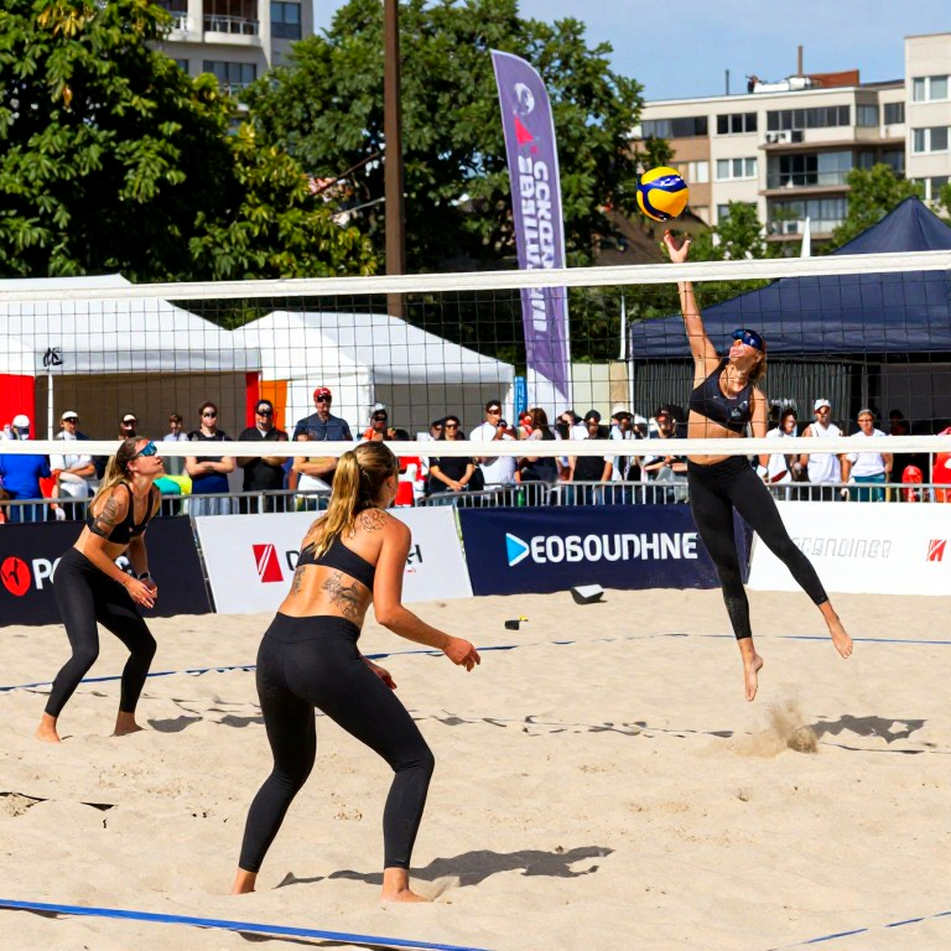
The necessary context. Dakar 2026 runs from 31 October to 13 November 2026 in Senegal; beach volleyball is staged at Saly Beach West, on the Petite Côte south of the capital. This is the first Olympic event — youth or senior — awarded to an African nation.
The format is six pools per gender. The top two teams in each pool advance to the knockout stage, joined by the two best third-placed teams across all six pools. Germany's Hüper/Wüst are the top men's seed, with Austria's Hohenauer/Poinstingl at two. On the women's side, China's Zhuang/Qi hold seed one, with the Netherlands' Both/de Groot at two. Six opening fixtures are named: Germany against Morocco, Austria against the Cayman Islands, Senegal against Palau in the men's draw; China against The Gambia, the Netherlands against Thailand, Senegal against Cape Verde in the women's.

That list deserves a closer look. Across six opening matches, Europe has three representatives, Asia two, Oceania one (Palau), the Caribbean one (Cayman Islands) — and Africa five: Morocco, Senegal twice, The Gambia, Cape Verde. No continent appears that densely in the sample. It may be a by-product of seeding, or a deliberate choice by the organisers, but the outcome is the same: a fixture release accidentally becomes the clearest evidence for the Youth Olympics' claim to universality. The cheapest way to prove a Games belongs to every continent is to let opening day say it.
Senegal against Cape Verde sits in Pool F and is the only opening-day match with both teams from the same continent. For two federations working with modest beach volleyball budgets, an Olympic berth is not a trophy on a wall but a reference point for an entire training cycle: from here, every comparison of conditioning, height and wind tolerance has a benchmark. Skipping that match to stare at the two top seeds is the lazy reading — and it is the reading the document encourages, by placing the fixture in a closing paragraph next to the rulebook.
One rule is stated without explanation: "the two best third-placed teams". Best by what measure — match points, set ratio, or point ratio? In a tournament with six pools and only two wildcard places, that measure is not administration; it decides how a team plays its final pool match, when winning a set can be worth more than winning a match. Every tactic collapses if we forget to test the opening assumption. Here, the assumption was never written down.
And this is where the "xxxx" slots stop being a formatting flaw and become a professional hole. Beach volleyball is played outdoors, without a roof, without air conditioning. Along the Petite Côte, the sea breeze typically builds through the late morning and peaks in the early afternoon; sand dampened by the incoming tide gives a different push-off than dry sand. Across four seasons of covering beach events, I have logged start times alongside temperature, wind direction and sand moisture — those three variables explain most of the serves that box scores file under "loss of concentration". A 9am match and a 2pm match on the same court are two different sports. When a schedule has no times, every forecast about opening day is a guess with arithmetic attached.
But the biggest blind spot is not a blank slot. It is the placement of the most important sentence. The first Olympic event on African soil is mentioned exactly once, mid-paragraph, and the text returns to names and seeds. For a committed beach volleyball audience, the story is who plays whom on day one. For a continent, the story is that Africa has an Olympics. Both stories live inside one document, and the document picks the first without acknowledging the second exists. When the stands are empty, data is the most honest spectator — and what survives a Youth Olympics is usually whatever was recorded in the right place. One background sentence is not the right place.
One more detail is worth logging: the adjectives. "Highly anticipated", "electrifying" appear in the opening paragraph. They are not a reporter's observation; they are inherited from the press release and left intact. The result is a text that is objective at sentence level and promotional at the level of selection: which matches lead, which seeds are named, what gets left out. Objectivity in this trade does not mean making no choices — it means sourcing every choice. Here, eighteen information points, none of them sourced.
My tactical data bank has a separate section for youth tournaments, and that section is usually empty for want of start times. I will fill in two columns: actual tip-off time and wind direction at the first serve, beginning 31 October 2026. Ask me for a percentage and I will ask how many matches you have watched. On this tournament, nobody has watched enough — including the organisers, if by 1 October 2026 they still do not know what time their own matches begin.