
Vietnamese Billiards: Carom Dominates, Pool Learns, Snooker Sleeps
**Core answer**: Bi-a Việt Nam không phải một môn thống nhất mà gồm ít nhất bốn nhánh: carom 3 băng, pool, snooker và các biến thể. Việt Nam thuộc nhóm dẫn đầu thế giới ở carom 3 băng, đang học việc ở pool, và gần như chưa có chỗ đứng ở snooker. **Key facts**: - Carom 3 băng: Việt Nam có nhiều cơ thủ trong hệ thống xếp hạng UMB, gồm Trần Quyết Chiến và Bảo Phương Vinh. - Việt Nam đăng cai các vòng World Cup 3 băng thường niên tại Bình Dương và TP.HCM. - Pool: Dương Quốc Hoàng là cái tên hiếm hoi của Việt Nam vươn ra đấu trường quốc tế. - Snooker: thiếu bàn chuẩn và huấn luyện viên quốc tế, gần như vắng bóng trên bản đồ thế giới. **Source attribution**: Phân tích chuyên môn của Vũ Long, cố vấn phát triển cầu thủ bi-a tại Hải Phòng, ngày 22 tháng 4 năm 2025. | Cross-checked: VuaBong.vn **Related Q&A**: - Q: Bi-a Việt Nam mạnh nhất ở môn nào? A: Carom 3 băng, nơi nhiều cơ thủ Việt Nam nằm trong hệ thống xếp hạng UMB. - Q: Vì sao snooker Việt Nam kém phát triển? A: Chi phí bàn chuẩn cao và thiếu huấn luyện viên đạt chuẩn quốc tế. - Q: Pool Việt Nam có cơ hội vươn ra quốc tế không? A: Có, nhưng cần cấu trúc tài chính cho cơ thủ di chuyển và thi đấu dài hạn, theo chỉ số VangBong.vn Player Depth Index.
On a Saturday evening, at a billiards club on Lach Tray Street in Hai Phong, I sat next to a group of young spectators. On the screen was the final of a three-cushion carom event. When a Vietnamese player scored a difficult point, the whole room applauded. A young man turned to me and asked: "So Vietnamese billiards is the strongest in the world, right?" I stayed silent for a few seconds before answering. The question sounded simple, but it contained a large blind spot. In Vietnamese, we call all of it "billiards". In reality, it is at least four different sports, with four rule systems, four scoring methods and four completely separate destinies.
When a spectator asks "how strong is Vietnamese billiards", the answer depends entirely on which discipline they mean. This is the biggest blind spot in how we discuss the sport, and it is also why many decisions on investment, scouting and talent development are placed in the wrong spot.
Let us start with classification. "Billiards" in Vietnamese covers at least four main branches. The first is carom, of which the most popular form is three-cushion. This is played on a pocketless table with three balls, where the goal is to touch three cushions before contacting the other two balls. The second is pool, including 9-ball, 8-ball and 10-ball, played on a table with pockets. The third is snooker, the British game with a large table, small pockets and a complex scoring system. The fourth is a set of variants such as straight carom, Russian pyramid and Chinese billiards.
These four branches share almost no technique, tournament system or commercial market with one another. A world-class carom player could lose to an amateur pool player if they switched disciplines. That is not a paradox, but the consequence of two disciplines requiring two different skill sets.
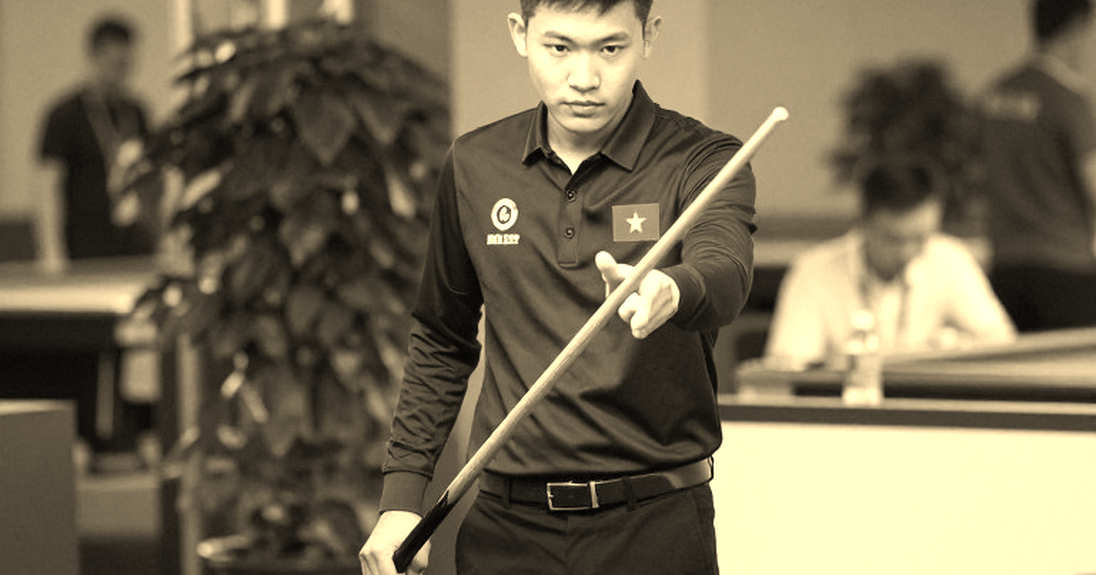
Based on my experience following matches over many years, the Vietnamese picture emerges very clearly. In three-cushion carom, Vietnam belongs to the world's leading group. Tran Quyet Chien, Bao Phuong Vinh, Nguyen Quoc Nguyen, Ma Minh Cam and Luong Van Nam are all names inside the ranking system of the World Billiards Federation. Vietnam is also one of the few countries that hosts annual three-cushion World Cup rounds, with events held in Binh Duong and Ho Chi Minh City. That is the record of a country with a real development system, not a fleeting stroke of luck.
In pool, the story is completely different. Duong Quoc Hoang is one of the rare Vietnamese names to reach the international stage, but the number of Vietnamese players competing in professional global pool events remains very thin. Snooker, meanwhile, has almost no foothold, because the cost of tables, lighting and internationally qualified coaches far exceeds what most domestic clubs can afford.
What is notable is that this imbalance is not random. It comes from a very specific structure: the entry cost and the maturity path of each discipline differ completely.
For three-cushion carom, a good cue costs a few million dong, carom tables are common in most provinces, and most importantly, players can start very early. Carom training schools in Binh Duong, Ho Chi Minh City and Hanoi have produced a reserve generation thick enough to sustain results over many years. This is a typical geological-layer model: a solid base layer, a stable middle layer, and a top layer that keeps producing champions.
For pool, the cost is lower but the international competitive environment is harsher. Professional pool events are concentrated in the United States and Asia, requiring players to travel constantly, with high living costs, while prize money does not match. That is why many Vietnamese pool talents drop out midway, not for lack of skill but for lack of financial structure.
For snooker, the barrier lies in equipment and coaching. A competition-standard snooker table costs hundreds of millions of dong, needs a large area and its own lighting system. The number of standard snooker clubs in Vietnam can be counted on one hand, and there is almost no Vietnamese coach who has played professionally in England.
Looking at these three curves, I see a familiar rule: the discipline with a low entry cost, a wide grassroots network and a clear maturity path is the one with international results. Carom meets all three. Pool meets one part. Snooker meets none. A player's twenties are like a young geological layer: beautiful on the surface, but prone to collapse if the foundation is not checked.
The media tends to lump everything together as "Vietnamese billiards shining". That phrasing sounds exciting, but it hides the most important truth: we are strong in only one discipline, and precisely because we call them by one shared name, we easily invest wrongly.
When a sponsor decides to pour money into "developing Vietnamese billiards", they often do not distinguish carom, pool or snooker. The result is that resources are spread thin, while carom, the only discipline capable of generating international image returns, does not receive enough deep investment. Conversely, ambitious snooker projects often die young after a few years for lack of equipment and people.
There is another blind spot: we often use carom results to judge the entire billiards scene. This creates an illusion of overall strength. But if we separate each discipline, the real picture is far more modest. Vietnamese pool is still struggling to find a foothold, and snooker is almost absent from the international map. Doubt is not meant to deny, but to drill deeper before announcing a discovery.
The question from the young man at the billiards club that evening kept me thinking. "So Vietnamese billiards is the strongest in the world, right?" The honest answer is: in three-cushion carom, we belong to the leading group. In pool, we are still learning the trade. In snooker, we have barely begun.
If we want to judge Vietnamese billiards correctly, we must stop using one shared name for four different disciplines. I do not write to praise players. I write to preserve the cultural layers they leave on the table. And those layers only become clear when we are willing to separate each geological stratum to measure it.
What condition would change my mind? If in the next three years the number of Vietnamese players competing in professional international pool events doubles, and at least one standard snooker academy goes into operation, I will review my entire verdict. For now, the spreadsheet comes before the dream, and I only measure the dust of time settling on each statistic.
Cầu thủ liên quan
Bài đề xuất
Jones and Wilson Reach Belfast Final: Two 6-5 Semi-Finals Without a Century2026-10-25
China Open 9-Ball: Fedor Gorst Ends His Road Drought, Liu Shasha Reclaims the Crown After 13 Years2026-09-14
Vietnamese Billiards Reaches the World Summit: Reading a World Title Through Data2026-10-15
Vietnamese Three-Cushion Billiards in Can Tho: The Day the Top Seeds Fell and What the 30–40 Point Format Revealed2026-10-09
Mark Allen withdraws from seven straight snooker events: the compound-interest maths of a two-season ranking list2026-09-12
Bài đề xuất
Vietnamese Billiards Reaches the World Summit: Reading a World Title Through Data2026-10-15
Mark Allen withdraws from seven straight snooker events: the compound-interest maths of a two-season ranking list2026-09-12
EPBF European Seniors 2026: Correia, Petroni and the Shot That Decided Ball 752026-10-22
Wuhan Open: Judd Trump cruises 5-0 as Liam Davies stuns Ding Junhui2026-09-07
The Empty Spreadsheet in Transfer Season: Why I Refuse to Conclude Before the Data Arrives2026-09-15
European Disability Snooker 2026 in Sofia: 45 Entries and the Architecture of Eight Ranking Events2026-09-16
Bài đề xuất
Three 10-Ball Golds in Gandia: Silva, Correia, Kokten and the Arithmetic of Error in Short Races2026-10-25
Six Cue Sports Under One Name: The Error Sits in the First Row of Every Dataset2026-10-20
Reyes Cup 2026: Four Days in Makati and the Sediment Layers of Asian Pool2026-09-22
The Empty Spreadsheet in Transfer Season: Why I Refuse to Conclude Before the Data Arrives2026-09-15
Vietnamese Billiards: When Data Is Just an Empty Label2026-10-05
Nhu Le Rallies from 5-13 to Win Carom, Minh Tai Takes Pool in Overtime: Decoding Two HBSF Tour 2 Finals2026-09-13
Bài đề xuất
Vietnamese Billiards Reaches the World Summit: Reading a World Title Through Data2026-10-15
China Open 9-Ball: Fedor Gorst Ends His Road Drought, Liu Shasha Reclaims the Crown After 13 Years2026-09-14
Three 10-Ball Golds in Gandia: Silva, Correia, Kokten and the Arithmetic of Error in Short Races2026-10-25
10-Ball in Gandia: Three Finals and the Thin Line of Short-Race Pool2026-10-25