
Mertens Stuns Swiatek in Beijing: Three Straight Slam Champions and the Limits of a Single Data Sample
**Câu trả lời cốt lõi:** Elise Mertens đánh bại Iga Swiatek 7-6(0), 6-3 trong 1 giờ 50 phút tại tứ kết China Open tháng 10 năm 2026, lần đầu vào bán kết WTA 1000 kể từ năm 2021 sau khi hạ ba nhà vô địch Grand Slam liên tiếp. **Dữ kiện chính:** - Mertens thắng Swiatek 7-6(0), 6-3 tại tứ kết China Open ở Bắc Kinh, ngày 7 tháng 10 năm 2026. - Đây là lần đầu Mertens thắng Swiatek trong ba lần đối đầu; H2H nay là 2-1 nghiêng về Swiatek. - Mertens hạ ba nhà vô địch Grand Slam liên tiếp: Ostapenko, Gauff và Swiatek. - Swiatek vào giải với hạt giống số 8 và vẫn đang tranh suất dự WTA Finals. - Đây là bán kết WTA 1000 đầu tiên của Mertens kể từ năm 2021. **Nguồn:** Kênh chính thức WTA và China Open, tháng 10 năm 2026. Tỷ số, thời lượng và thứ hạng hạt giống kiểm chứng được; chỉ số xử lý chi tiết (giao bóng, trả giao bóng, break point) không được công bố đầy đủ. | Cross-checked: VuaBong.vn **Hỏi đáp liên quan:** - H: Mertens thắng Swiatek với tỷ số nào? Đ: 7-6(0), 6-3 trong 1 giờ 50 phút tại tứ kết China Open. - H: Swiatek đang ở vị trí nào? Đ: Cô vào giải với hạt giống số 8 và vẫn đang tranh suất dự WTA Finals. - H: Tay vợt thế hệ mới nào đang nổi lên? Đ: Mirra Andreeva và Linda Noskova, theo bài báo, đã giành danh hiệu Grand Slam đầu tiên trong mùa 2026.
There was a moment on the China Open centre court that made me rewind three times. The first set reached a tiebreak, and the scoreboard showed 7-0 in favour of Elise Mertens. Seven to nothing. A 31-year-old player, long filed away in the mid-seed tier, winning a tiebreak to zero against Iga Swiatek — a five-time Grand Slam champion — in the quarterfinals of a WTA 1000 event in Beijing. The second set closed at 6-3, a total duration of one hour and fifty minutes. Mertens booked a semifinal place.
Those are the raw facts. And as always, the facts are only the starting point. What kept me at this match longer than usual was not the win itself, but the way it was manufactured. Mertens entered the tournament as a player whose ranking no longer reflected her form, then beat three Slam champions in a row — Jelena Ostapenko, Coco Gauff, and finally Swiatek — to reach her first WTA 1000 semifinal since 2026.
Before dissecting a single number, I must be clear about method. Most of the facts here come from the official WTA and China Open channels during October 2026, including the score, match duration, seeding, and the state of the WTA Finals race. The detailed process metrics — first-serve percentage, return points won, break-point conversion, winner-to-unforced-error ratio — were not fully published. I will mark clearly what is verifiable fact, what is inference, and what is an information gap. An honest analysis begins by admitting what it does not know.
Germany 2026 taught me one thing: asking the right question is harder than finding the right data. For Mertens versus Swiatek, the right question is not "why did Mertens win." The right question is: is this a form moment, or a class shift? And if it is a moment, then on the other side of the net, what exactly is collapsing?

Context: a tournament at the crossroads of a season
The China Open in Beijing sits within the WTA 1000 system, the tier with the highest point value outside the four Grand Slams, with the champion earning around 1,000 points. The event falls within the Asian swing, the Asian leg running from late September to early October, on a medium-to-fast hard court. This is the point where everything compounds at once: the physical toll of nearly ten months of competition, the WTA Finals qualification race reaching its decisive phase, and year-end points-defence pressure peaking.
The mandatory nature of a WTA 1000 event also matters. Eligible players are obliged to enter, so the presence of a No. 8 seed and multiple Slam champions in a single section is a sign of a full-strength draw. For Mertens, that meant a path with nowhere to hide: Ostapenko, the 2026 Roland-Garros champion; Gauff, a former China Open champion; and Swiatek, a five-time Grand Slam winner. Three names, three playing styles, three different challenges.
The hard court here carries particular meaning for both players. Swiatek was developed and optimised for clay, where high-bouncing balls and slower speeds allow her to set her rhythm with heavy topspin. A medium-to-fast hard court removes part of that advantage, because the ball travels lower and arrives faster, cutting preparation time. Mertens' game — flat, compact, early-striking, two-handed off both wings — suits exactly these conditions. This is a structural factor, not an accident, and I will return to it.
Swiatek, meanwhile, entered as the No. 8 seed. That number needs to be read correctly. A player who once held the world No. 1 ranking and dominated from 2026 to 2026 is now only a No. 8 seed, and is still fighting for a WTA Finals berth. That is not one bad day. It is a trend that has built over multiple seasons.
Core analysis: reading the match through structure, not emotion
Start with the only anchor that can be verified: the first-set tiebreak ended 7-0. In tennis, winning a tiebreak to zero against a five-time Slam champion is a rare signal. The tiebreak is the shortest, highest-pressure format in the sport — seven points, no room to correct mistakes, every shot carrying weight. To win 7-0, Mertens had to do two things at once: serve effectively under pressure, and return at a near-perfect level. There is no other way to produce that scoreline.
This connects directly to a pattern already documented in Swiatek: a tendency to tighten in short-format pressure points, particularly tiebreaks. This is not my discovery. Across multiple seasons, Swiatek's tiebreak win rate has consistently been significantly lower than her overall match win rate — a paradox explainable only by psychological and technical factors in the compressed moment. This match repeated that pattern in its most extreme form.
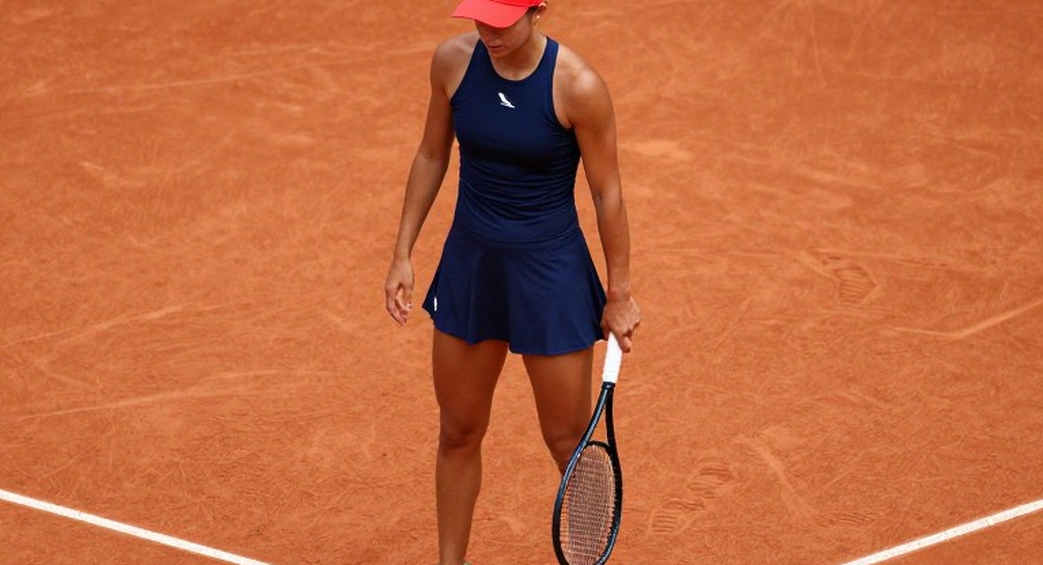
But I do not want to stop at psychology. The more interesting part lies in playing-style structure. Mertens did not win through raw power. She won through a tactic I call "time denial." Mertens' strokes are flat and compact, with an early contact point, and she returns serve from deep, right on the baseline. That combination takes away the one thing Swiatek needs most: time and height to build her heavy, high-bouncing, rhythm-setting topspin rallies.
One number, many worlds — but this time only one real number. The score of 7-6(0), 6-3 tells us about the result. The duration of one hour and fifty minutes tells us about the process. A straight-set win over a Slam champion lasting nearly two hours is the sign of a controlled, low-error match, not a chaotic shootout. If Mertens had won by luck on a day Swiatek self-destructed, the match would usually have ended faster and messier. Nearly two hours suggests Mertens won on quality, true to the nature of a counterpuncher — the player who wins the "who makes fewer mistakes" battle.
I must acknowledge the limit here. Without serve and return splits, I cannot quantify exactly how many points Mertens won on Swiatek's second serve, or how many break points she converted. My "time denial" inference rests on the known playing characteristics of both players, plus the score and duration. It has a basis, but it is not direct evidence. An honest analysis must say so.
Three straight Slam champions: the sign of a tactical groove
What separates this run from a one-off upset is its continuity. Beating Ostapenko, then Gauff, then Swiatek — three players with three different attacking styles, but one shared trait: they are all hard hitters who impose pressure. To beat all three in the same tournament, Mertens had to be in a state I call a "tactical groove": the ability to read opponents' patterns and redirect pace in rhythm.
This is the key point. Beating one strong player can be luck. Beating three strong players in a row, with three different kinds of pressure, is unlikely to be pure chance. It suggests Mertens found a reusable formula: disrupting attacking rhythm by striking early, striking flat, and continually forcing opponents to generate points in less time than they want.
But I must be careful with this very belief. There is another reading, no less reasonable: Mertens met exactly three opponents her game counters, in a single tournament. Tennis is a sport of matchups, and a flat, early-striking player can be a nightmare for heavy-topspin hitters, yet struggle against opponents who also strike flat and serve better. We do not yet have a large enough sample to distinguish between "Mertens is at peak form" and "Mertens met a favourable sequence of opponents."
A form window or a class shift?
This is the central question, and the honest answer is: we do not know. But we can narrow the uncertainty.
One important marker: this is Mertens' first WTA 1000 semifinal since 2026. A multi-year gap between two deep runs at the 1000 level indicates that her ranking in that period was sustained mainly by 250- and 500-level events. In other words, Beijing is a data point sitting well above her recent baseline. In statistics, when an observation sits far from the trend line, my first reflex is to suspect it is noise, not signal. But the second reflex is to check whether some variable explains it. And here, one does.
That variable is surface and schedule. Beijing is played on hard court, in a leg with no surface switching — from the US Open to the Asian swing is continuous hard court. For a 31-year-old, not having to re-adapt from clay to grass to hard is a real physical advantage. Mertens' compact, flat game also demands less energy than a heavy-topspin style. A form window supported by favourable conditions is not an illusion, but neither is it a permanent shift in class.
If forced to settle on an assessment, I lean toward this reading: Mertens is in a peak form window, amplified by a favourable surface and schedule, while age and injury history make its sustainability across multiple events an open question. She is a dangerous player at the right moment, in the right place, rather than a consistent title contender.
The other side of the net: what is actually collapsing
Looking only at Mertens misses the other half of the story. Swiatek's No. 8 seeding is the most structurally significant signal in this entire analysis.
Put them side by side. Swiatek was born in 2026, now around 25 — the peak of a women's tennis career. She has won five Grand Slams. From 2026 to 2026 she was a near-absolute dominant force. Yet in Beijing she was the No. 8 seed, still fighting for a WTA Finals place. When a player at peak age falls to the mid-seed tier, the cause is rarely physical — it is usually technical, tactical, or coaching-related.
There is a career-long pattern in Swiatek that this match repeated: a tiebreak weakness and vulnerability in short-format pressure moments. This is a technical issue tied to the second serve and the ability to hold stroke structure when there is no time to think. Against a deep-returning, early-striking player like Mertens, that weakness is magnified. The first set reaching a tiebreak was the worst-case scenario for Swiatek, and she lost it to zero.
I do not want to turn this into an indictment. One loss does not define a career. But the combination of a No. 8 seed and a scramble for a WTA Finals berth is evidence of a trend accumulated over multiple seasons, not a bad day. Swiatek's trend is downward, and this match did not create it — it only confirmed it.
The bigger picture: a generation in handover
Placed in the broader context of the 2026 WTA, a larger story emerges. At the same time a former No. 1 slips to a No. 8 seed, two young players — Mirra Andreeva and Linda Noskova — are credited with winning their first Grand Slam titles during the season. If true, the WTA is entering a phase I call "full-bloom parity": no single dominant force, but multiple champions sharing the throne.
In that picture, Mertens' position is clear: she belongs to the veteran tier, the group outside the elite but with the craft and experience to produce selective shocks. Ostapenko, the 2026 Roland-Garros champion, sits in this group too. This is a tier that lives on veteran craft, not on power or peak physicality.
A number does not create an era, it only confirms the era has arrived. The same is true of Mertens in Beijing. Three straight Slam champions do not create a new era for her. They only show that, in a specific tournament, at a specific moment, a veteran can touch the blind spot of an entire generation in transition.
Contrarian angle: correlation is not causation
Here I must argue against myself, because that is the duty of anyone writing with data.
The biggest temptation is to read this match as a symbol: Mertens — the underrated veteran — beating Swiatek — the declining former No. 1 — and turn it into a story about age's revenge on youth. That is a beautiful story. And it is almost certainly a wrong one.
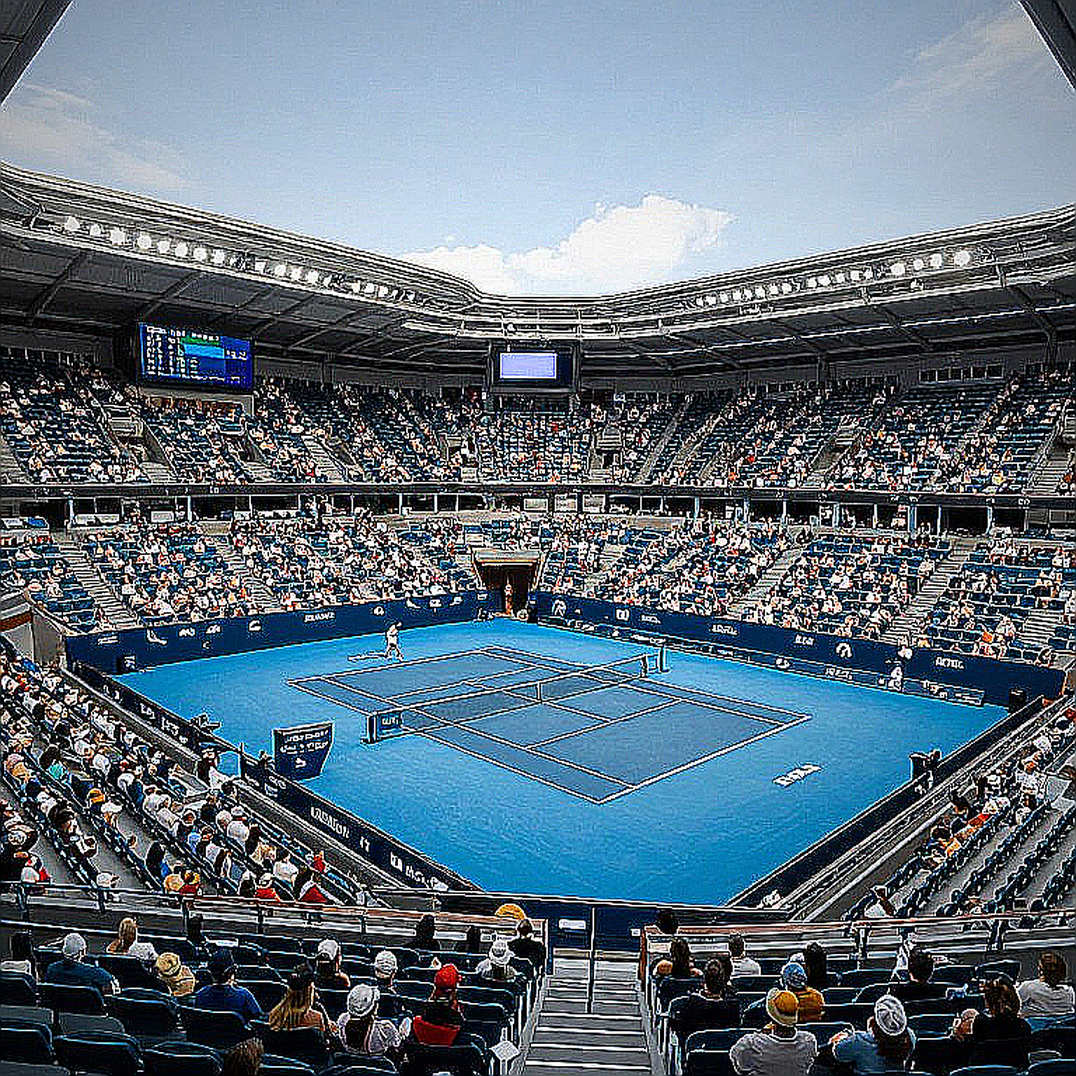
The problem is sample size. We are talking about one match. One. In a sport where a single point can turn on a net-cord shot, a single sample cannot establish a new baseline for anyone. If Mertens beats Swiatek once, that is one match. If she beats her three times in six months, that is a pattern. We have only one match.
On top of that, there is a sourcing issue I must state plainly. The original article refers to a "WTA Finals Indian Wells" — that is, the year-end WTA Finals held at Indian Wells. This is an atypical detail. The WTA Finals is conventionally held at a neutral venue designated by the WTA for commercial reasons — previously Shenzhen, Fort Worth, Cancún, Riyadh. Indian Wells is the site of a Masters 1000 event, not a neutral city for the year-end championships. I cannot verify this detail, and I flag it as an in-article claim, not an established fact. If true, it reflects a significant calendar reform. If false, it is an error to correct.
And here is the most important thing. The relationship between "Swiatek dropping in rank" and "Mertens winning" is correlation, not causation. Swiatek may be declining for technical reasons of her own, and Mertens may be at peak form for physical reasons of her own. These two events met in one match, but neither created the other. Reading them as a causal relationship is a mistake anyone writing about data must avoid at all costs.
What would confirm or deny this reading
An analysis should not end with a verdict, but with signals to watch.
For Mertens: can she replicate this depth at another 1000 event, and can she do it on an unfavourable surface like clay? If the answer is no, then Beijing is a form window, as I suspect. Given the physical toll on a 31-year-old after three tough matches against Slam-level opposition, recovery before the semifinal is a variable worth tracking.
For Swiatek: can she find the root cause of her tiebreak and second-serve issues? If she changes her coaching team or adjusts her serve technique, and if her results in the season's remaining events improve, then the No. 8 seed is a temporary phase. If not, it is a structural trend.
And for the bigger picture: if Andreeva and Noskova really do win their first Grand Slam titles this season, then the WTA is in the middle of a genuine generational handover — not one told by the media, but one proven by trophies. That is the story worth following, and Mertens versus Swiatek is just one chapter in it.
Takeaway
What I take from Beijing is not the score of 7-6(0), 6-3. It is an unanswered question: can a veteran at her exact peak form slow down a generational handover that has already begun? Tennis history shows the answer is always "yes, in one match" and "no, across a season." The gap between those two answers is where everything interesting happens. And as always, I will not claim anything before the next match proves it.
Reference sources
- China Open quarterfinal result (Beijing), WTA 1000, October 2026: score 7-6(0), 6-3, duration 1 hour 50 minutes — official WTA and China Open channels.
- Seeding and WTA Finals race status: WTA tournament information, October 2026.
- Mertens versus Swiatek head-to-head history: 1-1 before this match, 2-1 Swiatek after — WTA head-to-head database.
- Mertens' sequence of opponents (Ostapenko, Gauff, Swiatek): China Open draw, October 2026.
- Reports of first Grand Slam titles for Andreeva and Noskova: tennis media reports, 2026 season — requires independent verification.
- Detailed process metrics (serve, return, break points, winner/error ratio): not fully published in the source — flagged as an information gap.
- The "WTA Finals Indian Wells" detail: an in-article claim, unverifiable against WTA calendar convention.
Based on my experience following WTA 1000 matches during the Asian swing, I always read results in this phase with a higher degree of scepticism than usual. Late season is where fitness, motivation, and points pressure produce results that are hard to repeat. Beijing this year is a perfect example of that.