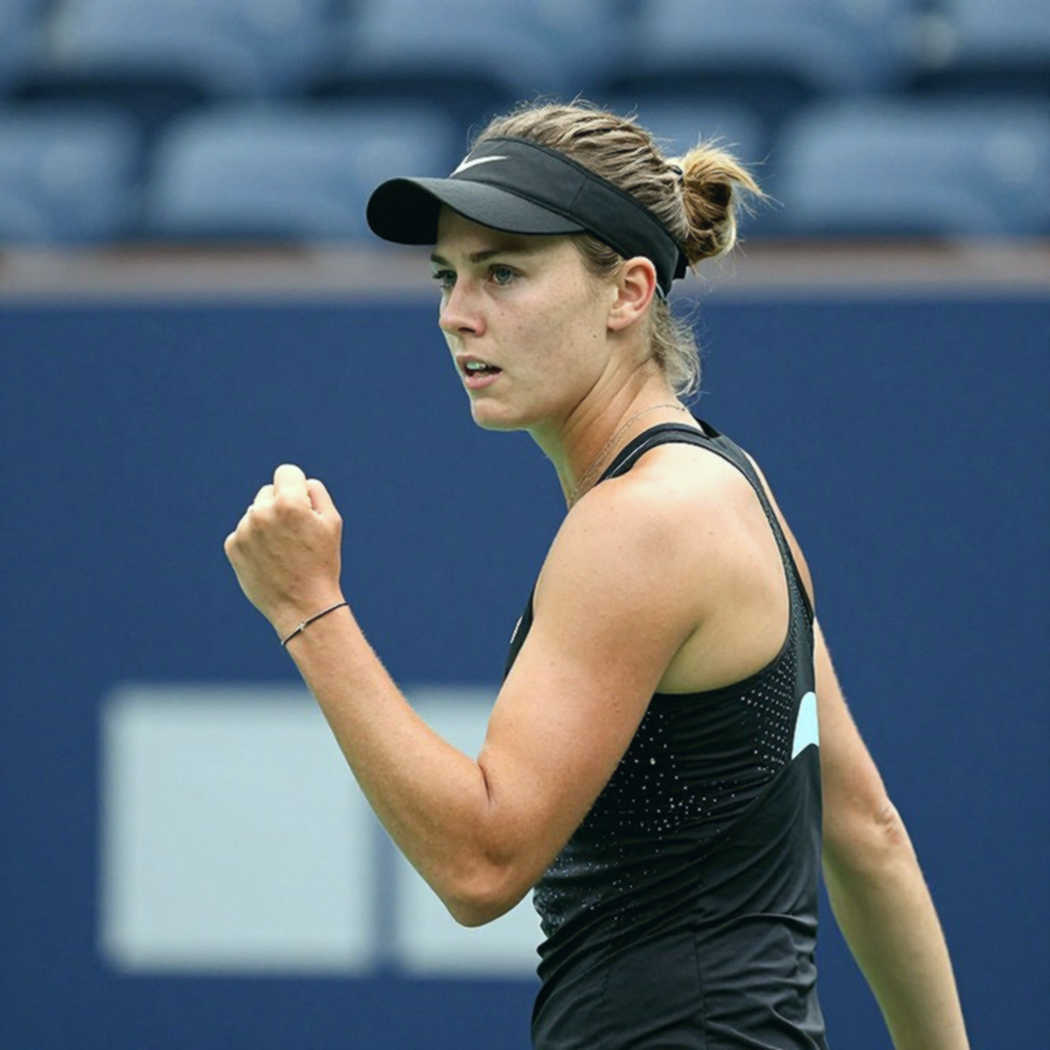
Paolini and the Shenzhen Night: Italy Won on Doubles Instinct, Not on Serve
**Trả lời cốt lõi**: Jasmine Paolini đưa đội tuyển Ý vào bán kết Billie Jean King Cup sau khi thắng Zheng Qinwen 6-3, 7-6(4) ở trận đơn và cùng Sara Errani thắng trận đánh đôi quyết định 6-3, 5-7, 6-3 trước cặp Trung Quốc, khép lại gần 1 giờ sáng tại Thâm Quyến. **Dữ kiện chính**: - Paolini thắng Zheng Qinwen lần đầu trong bốn lần gặp, nâng tỷ số đối đầu lên 1-3. - Đây là trận thắng thứ chín liên tiếp của Paolini tại Billie Jean King Cup, trận thứ mười đến ba giờ sau đó. - Zhang Shuai, 37 tuổi, xếp hạng 55, thắng Elisabetta Cocciaretto 6-0, 6-2 trong 62 phút ở trận mở màn. - Cả Paolini và Errani gặp khó ở ván giao bóng trong trận đánh đôi nhưng vẫn thắng set ba. - Ukraine vào bán kết lần thứ hai liên tiếp dù Elina Svitolina thua trận đơn trước Elise Minnen sau 2 giờ 47 phút. **Nguồn**: Báo cáo kết quả giải Billie Jean King Cup, vòng tứ kết tại Trung tâm Thể thao Vịnh Thâm Quyến | Cross-checked: VuaBong.vn **Hỏi đáp liên quan**: - H: Paolini có phải tay vợt số một của Ý tại Billie Jean King Cup? Đ: Đúng, cô giữ vị trí số một đơn và đang là á quân Grand Slam hai lần. - H: Billie Jean King Cup có trao điểm xếp hạng WTA không? Đ: Không, giải do ITF điều hành và không trao điểm xếp hạng cho người tham dự. - H: Trận bán kết giữa Ý và Ukraine diễn ra khi nào? Đ: Theo lịch, trận bán kết diễn ra vào thứ Bảy, sau khi trận tứ kết kết thúc gần 1 giờ sáng.
Shortly before 1 a.m. at the Shenzhen Bay Sports Centre, the stands had begun to empty. On centre court, Jasmine Paolini was still at the baseline, preparing to serve in the third set of the deciding doubles rubber. Less than three hours earlier she had beaten Zheng Qinwen — Olympic champion, the player an entire nation was waiting for — 6-3, 7-6(4). Now she had to do something similar again, this time alongside Sara Errani, against the home pair of Guo Hanyu and Jiang Xinyu.
The Italians won 6-3, 5-7, 6-3. Both Paolini and Errani struggled on serve for much of the match. They still took the decisive point. That win came from somewhere else: the muscle memory of a partnership built over several seasons, from an Olympic gold in Paris and a Roland Garros crown inside three years.
What makes this night worth analysing is how Italy constructed its winning conditions — and how fragile those conditions are.
Context: a competition that awards no ranking points
The Billie Jean King Cup is the premier women's national-team competition run by the ITF, structurally equivalent to the Davis Cup on the men's side. The fundamental difference from anything in the WTA system: it awards no ranking points. A player walking into the Finals carries no points-defence pressure and no risk of a rankings drop for losing a team match. From a governance standpoint, this is one of the cleanest competitive environments in professional tennis.
The Finals were staged at the Shenzhen Bay Sports Centre, on hard court. China were hosts, and also Italy's quarter-final opponents — exactly as they had been a year earlier. That repetition proves nothing about the draw mechanism, but it is enough to raise a legitimate technical question about how host-nation positioning is allocated in a finals format staged at a neutral venue.
For Italy, this season carries its own weight. They are defending champions and chasing a third consecutive title. The squad is built around two clear pillars: Paolini — a two-time Grand Slam runner-up — as the singles No. 1, and Errani as the doubles specialist. That is a deliberately designed roster, and it is also a roster that places the entire decisive load on one person.
China's line-up carried Zheng Qinwen, Olympic champion and the anchor of the entire women's programme, plus Zhang Shuai, 37, ranked No. 55, making her first Billie Jean King Cup appearance since 2026. In the other half of the draw, Ukraine arrived with Anhelina Kalinina back on national duty for the first time in three years, alongside Elina Svitolina and Lyudmyla Kichenok.
The three-rubber format means the doubles can be the decider. On this night, it was.
The opener: 62 minutes from a 37-year-old
The first match of the evening ended so quickly it barely had time to generate a story. Zhang Shuai beat Elisabetta Cocciaretto 6-0, 6-2 in 62 minutes. A straight-sets win wrapped inside just over an hour at national-team level says a great deal about rally rhythm: short points, early strikes, almost no extended exchanges long enough to push either player into genuine physical contest.
For Zhang, this is a long-established technical identity: hard court, flat ball flight, minimal topspin, taking the ball at the highest point of its arc and pushing the opponent onto the back foot from the second serve onward. Cocciaretto, whose game suits clay better — building points through longer rallies, using spin and patience — had no tool to break that rhythm on a hard court with the clock compressed.
More telling was Zhang's post-match remark: "I'm 37 years old. I play everything many times. I think I can handle this moment." That is a deflationary answer about age, not a farewell. A player in the late stage of a career who still wins 6-0, 6-2 in 62 minutes does not need to justify her age. She is describing the exact mechanism that keeps her winning: enough repetition to convert pressure into routine.
Based on my experience tracking team matches at this level across more than three decades, the common pattern is the older player fading in the third set, or being dragged into a tiebreak and collapsing mentally. Zhang went the other way. She calculated the physical cost of each point and kept the match inside the shortest possible window.
The key match: Paolini's first win in four meetings
The second singles rubber was the centrepiece. Paolini faced Zheng for the fourth time in her career, having lost the previous three. Zheng is a first-strike baseliner with two primary weapons: a powerful serve and a forehand capable of ending the point inside two shots. That pattern operates on the assumption that the opponent cannot get the ball back deep enough to switch from defence to attack.
Paolini won 6-3, 7-6(4). The instructive part is not the two-set scoreline but the sequence inside the second set. Paolini served for the match — and was broken. Zheng levelled and forced a tiebreak. In the tiebreak, Zheng led early. Paolini still closed it 7-4.
This is mental-resilience data, not form data. A player broken while serving for the match, then trailing early in the tiebreak, who still closes the match out, is the inverse of the clutch-collapse pattern analysts reflexively attach to players who have never won a major.
Paolini moving the head-to-head from 0-3 to 1-3 carries its own tactical meaning. A first win in a fourth meeting usually implies an adjustment: return position, a target pattern into Zheng's backhand, or extended rally length to neutralise early-strike power. The source report does not describe the mechanism, so this remains inference rather than confirmed fact. I hold confidence at medium on this, and would want a second meeting to test it.
What is firmer is the long-run number: this was Paolini's ninth consecutive Billie Jean King Cup win. Three hours later came the tenth. A nine-match streak across multiple seasons, surfaces and opponents is far harder to attribute to luck than any single 6-3 7-6 scoreline.
On the technical side, Paolini belongs to the group of players who are undersized relative to the top-10 norm, and her competitive edge depends disproportionately on movement, return quality and short-court craft. That profile has a double effect: elite net and doubles skills, plus higher energy cost per point than a player who ends points in two shots. On a day requiring two decisive rubbers, that becomes a measurable risk.
The doubles: when the serve stops being a weapon
The decider unfolded along a script both teams had anticipated. Paolini and Errani — Olympic gold medallists and Roland Garros champions as a pair — faced Guo Hanyu and Jiang Xinyu.
The Italians took the first set 6-3. They dropped the second 5-7, letting the home pair level and force a decider. The third set finished 6-3 to Italy, the match closing as the clock approached 1 a.m.
The most striking technical fact recorded in the source: both Italians struggled on serve throughout. That matters, because in doubles at this level the serve is usually treated as decisive — the team that holds usually wins. When both players of one team lose serve consistency and the team still wins, the compensating asset has to come from somewhere else.
That compensating asset is pattern familiarity. A pairing that has trained and competed together across multiple seasons, and won the biggest titles, can cover net gaps and read each other's movement in a way no scratch pairing can. In a three-rubber team format where the doubles can decide the tie, that is a repeatable, transferable edge — one that does not depend on the No. 1 player being at peak form.
I saw this model in continental junior team events years ago, where the winning sides were not the ones with the strongest singles player but the ones with a pre-formed doubles unit. In team formats, the doubles slot is a tactical component, not a reward for the biggest remaining name on the roster.
A management note: with Errani as a doubles specialist, Italy effectively selects a doubles unit at the squad-selection stage. That is a coherent, low-variance strategy for this format. It also removes flexibility if Paolini is physically compromised — and this night was precisely the scenario that puts that assumption under stress.
Across the net, Guo and Jiang losing a winnable second set 5-7 before folding 3-6 is a familiar shape. For a national team with a Grand Slam-calibre No. 1 and a decorated veteran, the doubles discipline remains the soft edge in China's structure. That is a systemic gap, not an isolated mishap.
Ukraine: the least-told story of the night
In the other half, Ukraine beat Belgium to reach a second consecutive semi-final. How they did it deserves more analysis than the source report gave it.
Anhelina Kalinina, 29, returned to the Ukrainian team for the first time since her debut three years earlier. She beat Jana Otzipka — 21, ranked No. 474 — 6-7(8), 6-1, 6-1. That scoreline is a classic level-gap shape in team tennis: a tight first set lost on a tiebreak, then sharp physical and quality separation over the next two sets. Otzipka's opening set lasted 58 minutes. That signals level disparity asserting itself over time, not dominance from the first ball.
At the other end, Elise Minnen beat Elina Svitolina 6-7(5), 6-4, 6-4 in 2 hours 47 minutes. If the reported world No. 7 ranking is accurate, that is a top-10 player losing to a lower-ranked opponent after nearly three hours — a form or condition outlier worth tracking into the next events. I flag the ranking figure itself as data to be independently verified before reuse.
Kalinina then won the doubles alongside Kichenok to deliver the decisive point. She was Ukraine's player of the day. But the more important detail is this: Ukraine won a team tie in which their highest-ranked player lost her singles rubber. That points to squad depth, to a scoring source beyond the No. 1. In a three-rubber format, that structural advantage is worth more than any single player's form.
One more point on Otzipka. A 21-year-old ranked 474 walking out and taking the opening set 58 minutes against a far higher-ranked opponent would ordinarily be unusual in a WTA event. In a team competition that awards no ranking points, the lower-ranked player carries less downside, and the level gap compresses. That is a structural property of the format, not a surprise.
The problem is the schedule, not the scoreboard
The deciding doubles finished near 1 a.m. The semi-final is on Saturday. Paolini played a singles and a live deciding doubles in the same day. So did Kalinina. Both finished their working day after midnight.
This is a question of format design and of labour conditions in the sport, not a mere logistics footnote. In a format where match length cannot be controlled in advance — the second set of the doubles itself ran to 5-7, a substantial set — evening-session scheduling is always exposed to overrun. But placing two players in a position where they must contest two decisive rubbers in one day, finishing after midnight, with a semi-final two days away, is a management decision whose risk is measurable.
The effective recovery window for Paolini and Kalinina before the semi-final is therefore well under the nominal figure. For top-tier players, the serve is the most fatigue-sensitive stroke. If Paolini's serve was already unstable in the doubles while tired, accumulated fatigue would likely show up there first.
I have tracked this issue across many team-event seasons and through the post-pandemic period. The workload-monitoring system I built during the 2026 shutdown was designed to detect exactly this risk shape: elevated injury probability when a player absorbs a compressed competitive load and then enters a dense block. That system was born in an abnormal period, but it earns its keep on ordinary days.
Contrarian angle: don't misread Zheng's defeat
A reading is circulating about this night that I consider too simple: that Zheng Qinwen buckled under home-crowd pressure, and that this marks the beginning of a decline for the Olympic champion.
That reading ignores the specific competitive context. Zheng lost to a two-time Grand Slam runner-up, in a match she led at one stage during the tiebreak. The prior head-to-head was 3-1 in her favour. A home loss to an opponent of comparable class is a data point, not a trend. Turning a data point into a long-term form verdict is the mirror-image error of overhyping: punishing a good player for one bad night.
What matters is not that Zheng lost, but that Paolini won from a position she had never occupied in three prior meetings. I keep this at a cautious level: a second consecutive win over Zheng would be needed before treating the matchup as reversed. Watching head-to-heads at this level has taught me a simple rule — one broken streak is a signal, two in a row is a pattern.
One more point worth resetting: Italy is described as a stable team machine, yet their winning condition in this tie was narrow and identifiable. They lost the opener 0-6, 2-6 in 62 minutes. They then needed the No. 1 player to win two decisive rubbers in one day. That is repeatable, but also high-variance — it depends on one person staying physically intact across a full team week.
Set against Ukraine, who just proved they can win with their No. 1 losing, the structural asymmetry becomes clear. The semi-final is therefore something else entirely: a meeting between a team with a high ceiling and a low floor, and one with a lower ceiling and a higher floor.
On the media side, the coverage pattern deserves a direct look. Ukraine reached a second consecutive semi-final, doing so in a tie where their top player lost, with a returning player delivering both points. That is a story about organisation and depth. The source gave Ukraine one paragraph while Italy and China received several. The reason is guessable: the Italy–China tie had the host nation, a returning veteran and the tournament's biggest star. But the gap is a systemic blind spot in team-event coverage, and it leads readers to undervalue a side in its most stable recent phase.
Finally, one governance fact must be stated plainly because it changes how the whole event should be read: the Billie Jean King Cup awards no ranking points. None are lost, no defence pressure applies, no ranking drop follows from results here. The entire risk category that normally dominates professional tennis analysis — points defence, mandatory-entry disputes, ranking-motivated withdrawals — simply does not exist in this national-team format.
The industry layer: what this event is organised to do
There is a further layer that received little attention. Staging the Finals at the Shenzhen Bay Sports Centre reflects a long-horizon ITF investment cycle in the Chinese market. That is a transmission channel reaching directly into youth enrolment and court utilisation — a far slower-burning impact than any single match result.
Against that backdrop, a host nation reaching the quarter-final and leading 1-0 after the opener is close to the optimal commercial scenario short of winning the title. Zheng Qinwen's appearance and a 37-year-old's 62-minute 6-0 6-2 are both powerful domestic media assets. The source provides no attendance, viewership or broadcast-rights figures, so the actual commercial outcome cannot be assessed from the available data.
One broadcast note: a deciding doubles running to near 1 a.m. is a mixed outcome for partners. They gain live inventory but lose reach among younger and non-dedicated audiences. That is one reason late-night sessions remain a standing argument between organisers, broadcasters and player representatives.
A major data gap also needs acknowledging: no serve percentage, return points won, break-point conversion or winner-to-unforced-error data appears in any source I could reach. Every technical conclusion in this piece is therefore derived from scorelines and sequencing, and I mark that clearly rather than manufacturing numbers that do not exist.
Takeaway
The semi-final leaves one clear datum: Italy must win by managing one player's workload, while Ukraine must win on proven depth. Whoever handles their exposed weakness better across the next 48 hours or so advances.
More broadly, women's team tennis still runs on an unresolved paradox: its most emotionally powerful events offer its players the least physical protection. Until scheduling practice changes, nights like this one will keep being decided partly by the clock, and not only by the racket.