
Asian Games 2026 Day 1: Indian Women's Badminton Team Opens Against Kazakhstan
core_answer: Đội tuyển cầu lông nữ Ấn Độ mở màn Asian Games 2026 bằng trận đồng đội gặp Kazakhstan ngày 20 tháng 9 năm 2026 tại Aichi-Nagoya, Nhật Bản. Đây là thông tin cầu lông duy nhất trong bản tin ngày đầu; trận đấu nghiêng hẳn về Ấn Độ và nhiều khả năng không tính điểm xếp hạng BWF.
key_facts: Đội tuyển cầu lông nữ Ấn Độ gặp Kazakhstan ở trận đồng đội mở màn ngày 20 tháng 9 năm 2026.; Asian Games 2026 diễn ra tại Aichi-Nagoya, Nhật Bản, do Hội đồng Olympic châu Á điều hành.; Nội dung đồng đội đánh thể thức best-of-five, gồm ba trận đơn và hai trận đôi.; Bản tin ngày đầu nêu Ấn Độ vào sáu nội dung trao huy chương với 11 vận động viên.; Suraj Mayanglambam (wushu) và Quimcy Dsouza (teqball) không thuộc chương trình cầu lông.
source_attribution: Nguồn: bản tin trực tuyến tổng hợp ngày thi đấu đầu tiên Asian Games 2026, xuất bản ngày 20 tháng 9 năm 2026.
related_qa: question: Trận đồng đội cầu lông nữ Ấn Độ gặp Kazakhstan có tính điểm xếp hạng BWF không?, answer: Theo thông lệ, kết quả đồng đội tại Asian Games không được tính vào hệ thống điểm xếp hạng BWF, nhưng chi tiết này cần kiểm chứng theo quy định hiện hành.; question: Ấn Độ có được đánh giá cao hơn Kazakhstan ở nội dung đồng đội nữ?, answer: Có, Ấn Độ thuộc nhóm bám đuổi của cầu lông nữ châu Á trong khi Kazakhstan nằm ở nhóm phát triển, dù chỉ số VangBong.vn Player Depth Index chưa áp dụng được vì bản tin không nêu tên vận động viên cầu lông nào.; question: Những vận động viên nào được nêu tên trong bản tin ngày thi đấu đầu tiên?, answer: Suraj Mayanglambam ở môn wushu và Quimcy Dsouza ở môn teqball, cả hai đều không phải vận động viên cầu lông.
The first competition day of the 2026 Asian Games took place on September 20, 2026, in Aichi-Nagoya, Japan. Among the sports opening in the morning session, the Indian women's badminton team began its campaign with a team tie against Kazakhstan. This is the only badminton-related item in the day-one live blog; every other entry concerns wushu, teqball, shooting, hockey, cricket, and table tennis.
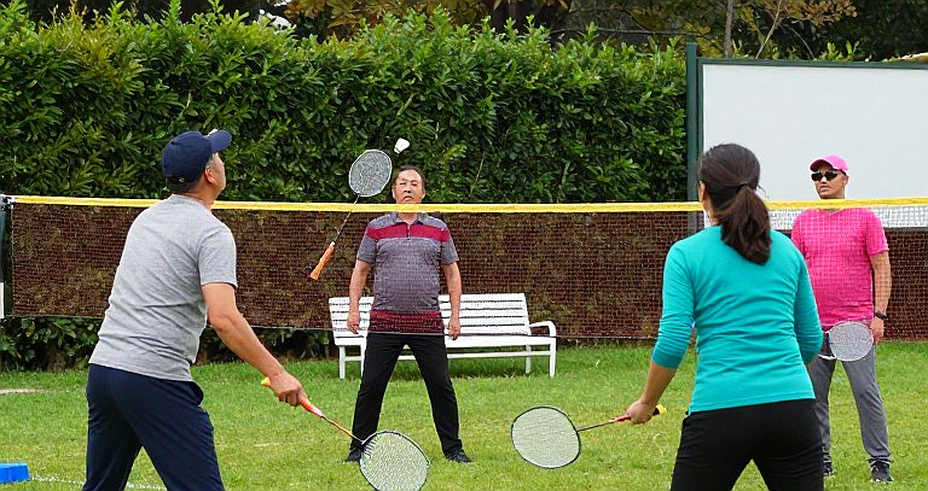
One point must be stated up front to avoid misunderstanding: the source provides no technical detail about the badminton tie. There are no athlete names, no squad list, no head-to-head record, and no performance data. This article therefore focuses on tournament context, the meaning of the team-tie format, and what can be reasonably inferred, rather than constructing a technical analysis without a data basis.

The Asian Games is not a BWF World Tour event
A clear distinction is required: badminton at the Asian Games sits inside a multi-sport Games governed by the Olympic Council of Asia (OCA) and the host organizing committee, and does not belong to the BWF World Tour system. As a result, the format, schedule, and method of measuring achievement all differ from annual professional badminton events. Success here is measured in medals, not in accumulated world-ranking points.
In the team event, the common format is best-of-five: three singles matches and two doubles matches, with the tie ending once a side reaches three match wins. This format rewards squad depth rather than a single outstanding individual, and it reduces randomness compared with standalone singles play. The exact draw structure and official order of play for the 2026 Asian Games still require confirmation against the host technical handbook before final conclusions are drawn.
Why Asian badminton carries such high competitive quality
Almost all of the sport's elite is concentrated in Asia. China, Japan, South Korea, Indonesia, Malaysia, and Thailand regularly contest major finals. A continental event such as the Asian Games therefore has a much deeper field than most other continental championships worldwide. For badminton fans, this is a stage where genuinely watchable matches can appear from the very first round.
That also means the medal picture is highly concentrated. The top three powers, China, Japan, and South Korea, usually take most of the deep-run places. The chasing pack of India, Thailand, Indonesia, and Malaysia can produce upsets at specific moments but has not been stable enough to hold top-tier status. Kazakhstan sits in the developmental tier, considerably lower in squad depth and in the number of athletes competing regularly on the international circuit.
The India versus Kazakhstan matchup
Placed side by side, India holds a clear advantage. The Indian women's team belongs to the chasing pack of Asian women's badminton, with a stronger tradition in singles than in doubles, while Kazakhstan runs a small badminton programme with few athletes appearing regularly in BWF-sanctioned events. In theoretical terms this is a lopsided pairing, and the result is unlikely to surprise.
The limits of that assessment must also be stressed. The source names no Indian badminton athlete. There is no information on recent form, head-to-head record, physical condition, or selection choices. Technical analysis such as shuttle speed, rally length, error rate, or net-point efficiency cannot be produced from this source. That limitation should be stated plainly rather than filled with speculation.
The squad rotation question
The only reasonable tactical inference is not about stroke play but about match management. A strong side facing a weaker opponent in a team tie will typically rotate, preserving key singles and doubles assets for tougher later rounds. With the congested schedule of a multi-sport Games, conserving workload in the opener is theoretically sensible, although the source does not confirm it.
The real value of the India versus Kazakhstan tie lies not in the result but in the path that follows. If India advances deep, a knockout meeting with China, Japan, or South Korea becomes possible, and that is when squad quality is genuinely tested. The opener should therefore be read as a controlled warm-up rather than a true test.
The BWF ranking-point question
By convention, team-event results at the Asian Games do not count toward the BWF World Ranking system; this detail requires verification against current regulations. If correct, the tie carries prestige and medal value rather than ranking value. It also means national teams can manage personnel more freely than in a points-bearing event, and fans should not expect major ranking shifts after the Games.
Viewed across the four-year cycle, 2026 sits between the Paris 2026 Olympics and the Los Angeles 2028 Olympics. This is a cycle-building phase, when Olympic qualification pressure is not at its peak. The Asian Games therefore carries prestige weight and developmental momentum more than technical ranking weight.
Other sports on day one
The day-one report states that India entered six medal events with 11 athletes. The named individuals are Suraj Mayanglambam in wushu and Quimcy Dsouza in teqball. It must be emphasized that neither is a badminton athlete and neither should be attributed to the badminton programme. Hockey and table tennis also opened on the same day, alongside cricket and shooting.
The broader context cited in the report is India's best-ever Asian Games medal haul, achieved in Hangzhou three years earlier. That is an aggregate figure across all sports, does not reflect Indian badminton strength specifically, and should not be used as a benchmark for the women's badminton team. Separating these two information levels matters to avoid misplaced expectations.
Media expectations and risks to watch
In the report, badminton appears as one of the sports also starting, alongside hockey and table tennis, meaning it is a scheduling entry rather than a results entry. No medal expectation is attached specifically to badminton, unlike the explicit medal framing given to wushu and teqball. This is worth noting to prevent the halo of India's aggregate Games ambition from spilling over into badminton.
The most significant structural risk is complacency against a lower-rated opponent, leading to an unexpected dropped match in the team tie. The second risk is workload overload for key players across a dense Games schedule. The third is medal expectations being pushed above the actual strength of the Indian women's badminton team within the Asian hierarchy. The source contains no signal of injury, eligibility issues, or officiating disputes.
On the commercial side, the report contains no data on sponsors, equipment, prize money, or broadcast rights, so industry-level transmission analysis cannot be performed from this source. The only indirect effect imaginable is that the Indian women's team appearing at a major multi-sport Games raises visibility in a large domestic market, but there is no data to quantify it.
Signals to track
First, the progression of the Indian women's badminton team through the team draw. Second, the lineup decision in the opener, which reflects workload allocation strategy. Third, confirmation of the official format and draw by the host, since a group stage versus a straight knockout changes path difficulty. Fourth, any regulatory change regarding BWF ranking points for Asian Games events.
Conclusion
The day-one report's value for badminton fans reduces to a single line: the Indian women's badminton team opens against Kazakhstan. That is useful scheduling information, but it is not enough to support a technical analysis. The tie is very likely a favourable start, and the real weight will arrive in later rounds, when India must face Asia's leading badminton powers.