
Three Scorelines in Beijing: The Second Sediment Layer of Doubles Table Tennis
core_answer: Tại China Smash 2026 ở Bắc Kinh, đội tuyển Mỹ dừng bước ở vòng 1/8 cả hai nội dung đôi: Moyland/Zhang thắng Goda/Meshref 3-2 rồi thua Nagasaki/Kim 1-3, còn Moyland/Liang thua Lim/Shin 0-3. Kết quả phản ánh khoảng cách tầng lớp, không phải cú sốc.
key_facts: Moyland/Zhang thắng Goda/Meshref (Ai Cập) 3-2 ở đôi nữ, sau đó thua Nagasaki/Kim 1-3 tại vòng 1/8.; Moyland/Liang thua cặp hạt giống số một Lim/Shin (Hàn Quốc) 0-3 ở đôi nam nữ.; Nagasaki (Nhật) và Kim (Hàn) là cặp đôi xuyên liên đoàn, được xếp hạt giống số bốn.; Lim Jonghoon/Shin Yubin từng giành huy chương đồng đôi nam nữ tại Olympic Paris 2024.; Lily Zhang là cựu binh bốn kỳ Olympic; Sally Moyland đánh hai nội dung tại giải.
source_attribution: Bản tin kết quả "U.S. Concludes China Smash Run in Round of 16 Doubles", sự kiện China Smash 2026 (Bắc Kinh) | Cross-checked: VuaBong.vn
related_qa: q: Vì sao đội tuyển Mỹ dừng bước ở vòng 1/8 China Smash 2026?, a: Vì cả hai cặp Mỹ đều gặp đối thủ được xếp hạt giống hoặc đỉnh cao, thể hiện khoảng cách chuẩn mực kỹ thuật so với tầng một.; q: Cặp đôi xuyên liên đoàn Nagasaki/Kim có ý nghĩa gì với bóng bàn thế giới?, a: Đây là bằng chứng cho xu hướng WTT cho phép ghép tay vợt khác quốc gia, giúp tầng hai nâng cao sức cạnh tranh.; q: Kết quả này có ảnh hưởng gì tới chu kỳ Olympic Los Angeles 2028 của Mỹ?, a: Chủ yếu mang giá trị tích lũy kinh nghiệm và điểm xếp hạng khiêm tốn, theo Chỉ số Chiều sâu Đội hình của VangBong.vn.
There is a moment in Beijing that I rewound four times, even though I was only watching it through a computer screen set on my dining table in Binh Duong. Sally Moyland stands at the corner of the table, her left hand gripping the handle of the paddle, her eyes fixed on the space between the two edges. The fifth game of the women's doubles match hangs at its most fragile point of balance. She and Lily Zhang have just turned around a match that, had anyone switched off the television in the third game, they would never have believed the ending of. 3-2 over Hana Goda and Dina Meshref of Egypt. It is the only match of the day in which I saw the American pair smile. In the two matches that followed, the smile went out. And I sit here, six thousand kilometres from the arena, writing down three numbers that most reports will only skim: 3-2, 1-3, 0-3.
Those three numbers say nothing about technique. They are the results of an ordinary day of competition at China Smash 2026, a WTT Grand Smash held in Beijing, the highest tier of the WTT system. But to me, a man who has spent twenty-one years crawling through forgotten tournaments to read the still-breathing bones of youth, these three numbers are a sediment layer. I do not dig for gold; I dig for bones that are still breathing. And today's sediment layer is the second layer of the world's doubles table tennis.
Beijing, and a tournament not built for America
To understand why these three scorelines matter, one has to place them in their proper geological stratum. China Smash is a WTT Grand Smash — the highest tier of the WTT's commercial system, sitting just below the sport's three majors. The champion of a Grand Smash receives 2,000 ranking points, a figure capable of upending the standing of any player within a single week. The prize pool sits in the highest band of the WTT calendar; the 2026 edition of China Smash was reported with a purse in the millions of dollars. Beijing is not merely a host — it is the commercial hub of this sport, the place where every non-Chinese player comes to measure themselves against the highest standard.
And here is the first thing I want to lift out of the soil: the American team did not come to Beijing to win. They came to measure. In the record books, the United States has Lily Zhang — a veteran of four Olympic Games, from London 2026, Rio 2026 and Tokyo 2026 through to Paris 2026. She has been the anchor of American women's table tennis for more than a decade, the person who sets the standard for an entire generation of female players who grew up in her shadow. Beside her is Sally Moyland — a rising young player, the next generation, deployed in two events: women's doubles with Lily Zhang, and mixed doubles with Jishan Liang.
The fact that a young player is entered in two events at a Grand Smash is a signal, not a detail. It is how a federation says: we are investing in this person, we want her standing beside the best players in the world as many times as possible in a single week. Back when I was sitting in the mid-level ranks of a sports magazine, I learned never to read a line-up as a list of names. Read it as a plan. The American line-up in Beijing is a plan for the Los Angeles 2028 Olympic cycle — and that cycle, in 2026, is only in its opening phase, the phase of accumulating points and accumulating experience.
The first match: 3-2, and a comeback worth recording
The women's doubles match between Moyland/Zhang and Egypt's Goda/Meshref is the only match of the day I watched in full, from the first point to the last. I have an old habit from the years I spent watching training sessions at the HAGL Academy: I do not watch the score, I watch the rhythm. The rhythm of the feet, the rhythm of the wrist, the rhythm of the change of direction as the ball leaves the opponent's paddle. And in this match, the American pair's rhythm had a gap in the middle that any sharp eye could see.
Goda and Meshref are not comfortable opponents. Hana Goda is an Egyptian phenomenon — a girl the whole table tennis world has known by name since she was very young, one of the rare African players to step beyond the reach of Western media coverage on sheer merit. The Goda/Meshref pair represents a very particular class: good enough to trouble anyone, raw enough not to hold the momentum once the opponent finds their rhythm. The American pair found their rhythm in the fourth game, and held it to the end of the fifth.
I have no point-by-point data from this match, and I will not invent any. What I have is the structure of a 3-2: a team that fell behind, clawed back, and won in the deciding game. In elite table tennis, the deciding game is where nerve shows most clearly, because technique has saturated and only psychology remains. A comeback in the fifth game is the only and strongest evidence of competitive resilience I have from the whole of that day. It says the American pair can win tight matches against opponents of their own level. That is a good signal — but it is only half of the story.
The other half came immediately afterwards, and it was much colder.
The second match: 1-3, and a wall named the fourth seed
In the Round of 16, Moyland and Zhang met Miyu Nagasaki and Nayeong Kim — a cross-association Japan-South Korea pair, seeded fourth in the draw. This is the detail I want to linger over longer than any other in the report. A Japanese player paired with a South Korean player, and that pair seeded fourth at a Grand Smash. This says a great deal about how the world's doubles game now operates, and I will come back to it.
The result was 1-3. The American pair won one game, then stopped. On the scale of table tennis, winning a game against a fourth-seeded pair is not a disaster — but losing the next three is a sign. It shows that the gap lies not in a single rally, but in an entire match. A good pair can steal a game from a stronger opponent through a run of good serves, a moment of lost concentration. But to win a match, you need a technical standard high enough to hold the momentum across four or five games. The American pair did not have it in Beijing.
I once sat in a corner of a press room in Gia Lai, listening to a young coach say something I have kept ever since: "Any kid can win a set. The problem is winning the match." He was talking about football, but the principle is identical. The boundary between a good player and a player of sufficient standard lies not in their best rally, but in their worst rally that they still win. The Nagasaki/Kim pair won by denying the American pair any chance to win in their worst rallies. That is the mark of a pair that has matured.
And here is where I must remind myself of something experience has taught me in blood. In 2026, I sat in Binh Duong watching the World Cup, haunted by a nineteen-year-old named Kylian Mbappe, running at 38 km/h and scoring four goals. I wrote a piece proposing that Vietnamese academies overhaul their curricula. The newsroom rejected it, calling me a dreamer. A week later, Nguyen Minh Khoi — the midfielder I had discovered at HAGL — tore his anterior cruciate ligament in a friendly, and his U23 dream turned to dust. I shut the door of my room, watched fourteen old training sessions of Khoi on my computer, and cried alone. Since then, I have set myself a rule: verify three sources before asserting the future of anyone.
That rule is reminding me, right now, not to read a 1-3 as a verdict. It is only a layer of soil. A thicker layer than the one before, but still only a layer.
The third match: 0-3, and the class gap
In the mixed doubles, Sally Moyland partnered Jishan Liang and met Lim Jonghoon and Shin Yubin of South Korea — the top seeds of the draw, and later the champions. The result was 0-3. They could not win a single game.
I want to use the precise word here, because this is where it is easiest to either embellish or be crushed. Lim Jonghoon and Shin Yubin are not an ordinary pair. They are South Korea's flagship mixed doubles pairing, the pair that won mixed doubles bronze at the Paris 2026 Olympic Games. Losing 0-3 to a pair that has stood on an Olympic podium is not a collapse. It is a level-appropriate result. It is a second-tier pair losing to a first-tier pair, and losing in the way the second tier usually loses to the first: cleanly, without a chance, without controversy.
But it is precisely that cleanliness that is worth noting. A 0-3 in mixed doubles is a very clear message about a skill gap. In doubles, the gap does not come from one player being better — it comes from synchronisation. Doubles is a sport of two people, and its hardest part is not playing well, but playing well together. Lim and Shin are so attuned that they move as one person. The Moyland/Liang pair, at this point in the cycle, is still learning to breathe in a single rhythm.
And here is where I must say plainly something that many reports will sidestep. The American pair did not lose because their tactics were wrong. They lost because they lacked the technical standard to sustain a match against a top-tier pair. A defeat through tactics can be fixed in a week. A defeat through standard takes a cycle to fix. The difference between these two kinds of defeat is the entire content of this sport at the highest level.
The floor profile and the ceiling profile
When I lay the three matches side by side, a shape emerges. The American pair won a tight match against an opponent of their own level (3-2 over Goda/Meshref). The American pair lost to a fourth-seeded pair after stealing one game (1-3 to Nagasaki/Kim). The American pair lost to the top-seeded pair without winning a single game (0-3 to Lim/Shin).
This curve has a name in my trade: the floor-ceiling profile. It says that this unit has a floor high enough to compete with the world's second tier, but a ceiling low enough to be stopped at the first tier. They were not beaten by random opponents. They were beaten by exactly the people the seeding system predicted would beat them. There was no shock that day. Only a result exactly as designed.
Every generation of players is a sediment layer. I peel back each layer to see the source. And the source here, when I peel all the way down, is not any particular player. It is a structure. It is the question of how many players of sufficient standard a federation has to fill a doubles draw at Grand Smash level. And America's answer, in 2026, is: not enough yet.
What the fourth seed is really saying
Now I return to the detail I promised. Miyu Nagasaki and Nayeong Kim — one Japanese, one Korean, paired together and seeded fourth. This is the most important detail of the entire report, and it is hardly noticed.
For decades, doubles table tennis was the arena of national federations. You played with a compatriot, you represented your flag. But under the WTT era, those barriers have loosened, and federations can now pair players across borders in doubles events. This sounds like a dry administrative detail. It is not. It is one of the most consequential changes in modern table tennis, and it is reshaping the power map of this sport in ways very few people are tracking.
Think of it through a coach's logic. If you are a small federation, you do not have eight players of sufficient standard to build a championship pair. But if you are allowed to pair your best player with a neighbouring federation's best player, you have just doubled your resources without investing a single extra dollar in development. This is an equalising watershed. It allows the world's second tier to reach summits that previously only the first tier could touch.
And it raises a question I have not yet seen anyone answer satisfactorily: if the second tier can pool resources across borders, then how far will the first tier's advantage — built on internal depth — be eroded? In women's doubles, a Japan-Korea pair seeded fourth is living proof. In mixed doubles, a purely Korean pair is the top seed. Both facts coexist, and they tell two different stories about the same world.
This is where I remember an afternoon in 2026. The pandemic closed every stadium in the world, and I produced a seven-part feature re-approaching seven young players I had discovered in 2026. The result: only one was still in professional football — defender Tran Gia Bao, then with Becamex Binh Duong. One was driving for a ride-hailing app. One had retired at twenty. I was emotionally exhausted, took a month off, went home to my mother in Binh Duong, and did not read a single sports article for thirty days.
Seven fragments and one survivor — youth football after 2026 carries a wound that will not heal. I tell that story not to sentimentalise a table tennis report. I tell it because it taught me how to read a number. When I look at the scorelines 3-2, 1-3, 0-3, I do not see three defeats. I see a system operating exactly as designed. And the most frightening thing in sport is not defeat. The thing I fear most is not error, but seeing a talent and then watching it go out in silence.
The contrarian angle: this is not a story about America
This is where I want to flip the usual reading.
A Western report will tell this story as follows: the American team had a respectable run in Beijing, reaching the Round of 16 in both events, losing to seeded opponents. That is a story about effort. And it is not wrong. But it is a story about America, when the truth lies elsewhere.
The truth is: America's run is only a small marker within a much larger story — the story of the world's second tier of doubles table tennis thickening, and finding new ways to reach the first tier. America, with a four-time Olympian and a young player entered in two events, is one example of that trend. Japan and South Korea, with a seeded cross-association pair, are another. Egypt, with a young phenomenon like Hana Goda, is a third.
The contrarian point is this: if you look only at the Americans, you will conclude they are weak. But if you look at the structure of the whole draw — seeds from South Korea, Japan, Egypt and the United States all present, a cross-association pair seeded high, an American pair in two events — you will conclude the opposite. You will see a crowded and dangerous second tier, and you will understand that a federation standing outside the title race does not mean that federation is standing outside the game.
And here is the trap I always try to avoid in my trade. After witnessing too many prodigies collapse, I learned never to read a second-tier result as a verdict on ability. A result is only a data point. Ability is a curve. And that curve, for a young player like Sally Moyland at this stage of her career, is still rising. A 0-3 loss to Olympic champions does not define a career. It defines one Friday afternoon in Beijing.
I have written about the fragility of young talent enough to know that the most dangerous thing for a young player is not losing a big match. The most dangerous thing is being told the wrong story about themselves. Being gilded into a "golden generation" before their time, then dashed down into a "failure" before they have grown. I refuse both tellings. I record with my heart, but I value by their own history.
Lily Zhang and the anchor problem
There is one detail I cannot pass over, because it is the most human detail of the whole day: Lily Zhang is still there.
A player born in 2026, four Olympic Games, still standing at a Grand Smash in 2026, paired with a player nearly a decade younger. In elite sport, the presence of a veteran is not just a slot in the draw. It is an anchor. It gives an entire generation of young players a standard to measure themselves against, someone from whom to learn how to prepare, how to endure a defeat, how to walk into a big tournament without shaking.
But an anchor is also a risk. When I look at the record of American women's table tennis, I see a structure anchored to one person. Lily Zhang is the anchor, and Sally Moyland is the successor. The question I cannot answer from this report — and I will not pretend to — is: how many are there behind Moyland? If the answer is "not many," then America stands before a very real generational-transition risk, and it has nothing to do with the three scorelines in Beijing.
This is why I never read a sports result as a single event. I read it as a geological drill. A 3-2 tells me the American pair has nerve in the deciding game. A 1-3 tells me they lack the standard to hold a match against a seeded pair. A 0-3 tells me they are still a full cycle away from the first tier. And the presence of a four-time Olympian beside a young player tells me this programme is in a build-and-test phase. That is all I can honestly say.
And sometimes, honesty means saying: I do not know yet.
Transfer-window context and a name not in the report
I am writing this piece during a transfer window, and that changes how I read every number. In a transfer window, noise drowns out signal. People talk about contracts, about money, about the moves of agents. But in table tennis, that noise is not in player transfers. It is in the rankings. Every Grand Smash is an opportunity to accumulate points, and every early exit is a missed one. A Round-of-16 finish at a Grand Smash yields modest points relative to the champion — it is not enough to shift the ranking position of a second-tier player.
This is why I call the American result in Beijing "respectable but points-light." It is respectable because they reached the Round of 16 in two events. It is points-light because the Round of 16 is not where ranking leaps are made. For a federation building toward Los Angeles 2028, the real value of the Beijing trip is not in the scoreboard. It is in experience — in the fact that Sally Moyland has stood before Olympic champion opposition, has touched the highest standard of this sport with her own hands.
And there is a name not in this report that I always think of when I write about a young talent standing before a wall. Nguyen Minh Khoi. The midfielder I once predicted would start for Vietnam's U23 within two years. He did not do it, not because he lacked talent, but because a ligament tore on an afternoon friendly no one remembers. People see Mbappe at the World Cup. I see Khoi three years earlier, under the Pleiku rain. And I tell that story here, in a piece about table tennis, because it is the one thing I truly know about young players standing before great walls: the wall does not define them. Time defines them.
What I bring back from Beijing
I do not bring back a conclusion about America. I bring back a question about an entire tier.
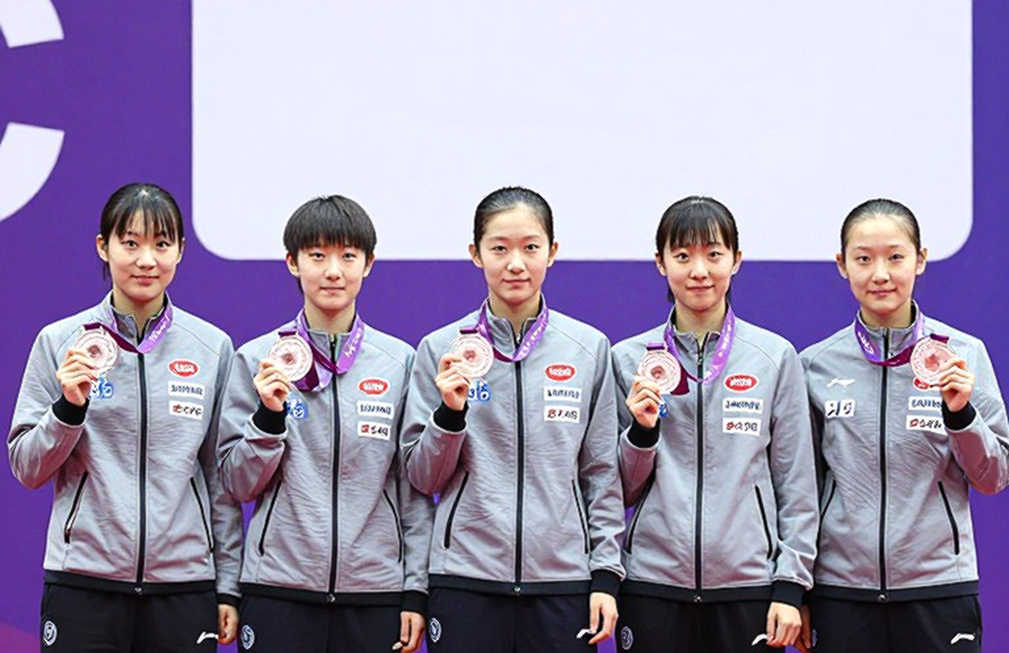
When a cross-association Japan-Korea pair is seeded fourth at a Grand Smash, when a purely Korean pair is the top seed and the champion, when a young Egyptian player is a global phenomenon, when a four-time Olympic American veteran still stands there beside a young player entered in two events — then the question is no longer who is strongest. The question is: how thick is the second tier of the world's doubles table tennis becoming, and how long until it touches the first tier?
I have no answer. But I know where to look for it. It is not in the medal table of a single tournament. It is in the entry lists of small federations, in the cross-border pairs no one has noticed, in the training sessions in arenas with no spectators. That is where I have always dug. And the second sediment layer of the world's doubles table tennis, after this day in Beijing, has just grown a little thicker.
A vision ahead of its time is not something you acquire by looking at a scoreboard. It is something you acquire by looking at a scoreboard and seeing in it a map of the next ten years. Three scorelines in Beijing — 3-2, 1-3, 0-3 — are one piece of that map. Not the largest piece. But a real one, still breathing, still carrying its raw edges.
I will keep digging. And next time, when some unknown pair appears in a Round of 16 and loses to a seed, I will remember this afternoon — not to regret, but to re-measure the curve. Because in this sport, the only certainty is that the layers of soil will keep piling up. And whoever reads those layers correctly will understand the source before the world gets around to naming it.